For more than a century, professional culinary textbooks and kitchen dogma instructed chefs to execute the “sear-and-bake” method: searing a raw thick-cut steak in a scorching-hot skillet or directly over blazing charcoal coals before transferring it to a moderate oven to finish cooking through. While this traditional technique works adequately for thin cuts, applying it to thick bone-in ribeyes, porterhouses, or prime rib roasts produces an unavoidable, disappointing defect: the dreaded “bullseye” grey band. The exterior 30% to 50% of the meat is severely overcooked, dry, and gray, leaving only a tiny core of rare pink meat in the dead center.
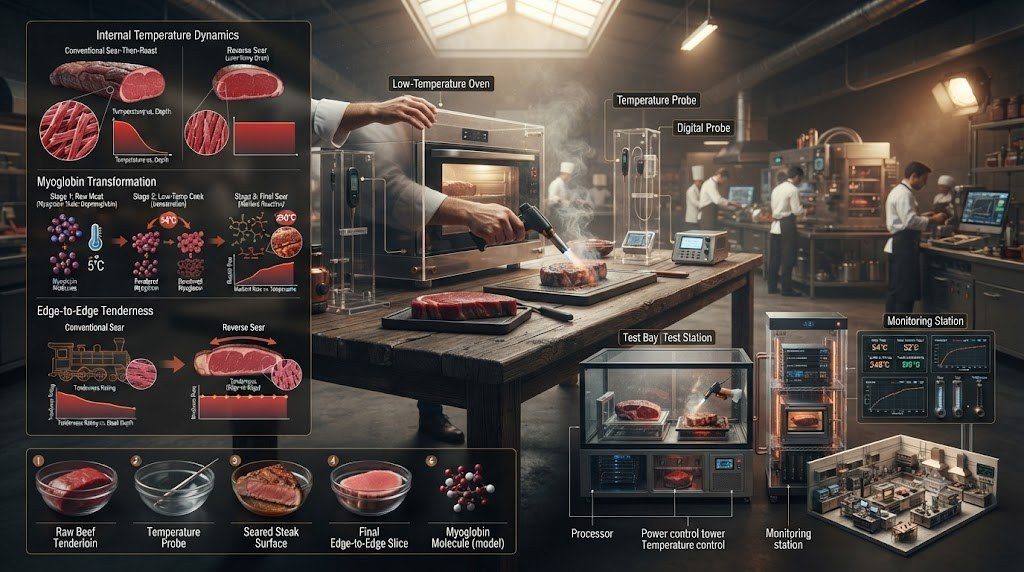
Pioneered by culinary scientist J. Kenji López-Alt and food writer Christopher Kimball, the Reverse Sear Technique completely flips this paradigm on its head. By gently bringing the steak up to target internal temperature in a low-heat, convection environment before executing a blistering, 60-second finishing sear, the reverse sear achieves what thermodynamic physics once deemed impossible: 100% edge-to-edge perfect pink medium-rare doneness enveloped in a paper-thin, mahogany, crackling crust.
This comprehensive technical treatise analyzes the thermal physics, myoglobin biochemistry, and surface dehydration kinetics of the reverse sear. It details heat transfer gradients, evaluates enzymatic tenderization via calpains and cathepsins during slow warming, explores the thermodynamics of surface moisture barrier removal, analyzes the Maillard reaction at 175°C, and provides a quantitative cooking matrix for home and commercial kitchens.
1. The Thermodynamics of Thermal Gradients: Traditional Searing vs. Reverse Sear
To understand why the reverse sear works, one must analyze the mathematical equations of transient thermal conduction in solid food, modeled via the One-Dimensional Heat Diffusion Equation:
\frac{\partial T}{\partial t} = \alpha \frac{\partial^2 T}{\partial x^2}
Where (T) is temperature, (t) is time, (x) is depth into the steak, and (\alpha) is the Thermal Diffusivity of meat (approx. (1.3 \times 10^{-7} \text{ m}^2/\text{s}) for raw beef muscle). Meat is primarily water (approx. 72% to 75%) and acts as a poor thermal conductor.
1.1 The Traditional Searing Defect: The Severe Thermal Gradient
When a cold, raw 4 cm (1.5-inch) thick steak at 4°C is placed directly onto a 260°C (500°F) cast iron skillet:
- The temperature delta ((\Delta T)) between the skillet and the meat surface is a massive 256°C. Under Fourier’s law ((q = -k \nabla T)), heat floods into the exterior surface far faster than it can diffuse into the interior core.
- By the time the thermal energy penetrates 20 mm to warm the center to 54°C (130°F, medium rare), the outer 10 to 15 mm of muscle tissue has been held at 80°C to 100°C for several minutes.
- This creates a steep, parabolic temperature gradient known as the “Bullseye Effect”: a burnt exterior crust, a thick layer of overcooked grey well-done meat, a rubbery ring of medium meat, and a tiny central core of medium-rare meat.
1.2 The Reverse Sear Solution: Flat Isothermal Heating
The reverse sear eliminates this steep gradient by decoupling cooking into two distinct thermodynamic phases:
- Phase 1: Gentle Low-Temperature Convection (105°C to 115°C / 220°F to 240°F): The meat is placed on an elevated wire rack in a low-heat smoker, grill indirect zone, or convection oven. Because the temperature delta is minimal ((\Delta T \approx 50^\circ\text{C})), heat diffuses slowly and uniformly. The entire cross-section of the steak warms at near-identical rates, establishing a virtually flat, isothermal temperature profile from edge to edge.
- Phase 2: Ultra-Fast High-Heat Flash Sear (260°C to 300°C / 500°F to 600°F): Because the interior is already at 50°C (122°F), the final sear is executed for only 45 to 60 seconds per side. This brief burst of high heat penetrates only 1 millimeter into the surface, forming a crisp crust without overcooking the underlying meat.
2. Meat Biochemistry: Myoglobin Transformation and Protein Denaturation
The culinary perception of meat doneness, tenderness, and juiciness is governed by the thermal denaturation temperatures of three primary muscle proteins:
| Muscle Protein | Denaturation Temp | Physical & Structural Transformation | Impact on Texture & Moisture |
|---|---|---|---|
| Myosin | 40°C – 50°C (104°F – 122°F) | Thick filaments unfold and coagulate; cell membrane permeability increases. | Meat firms slightly from raw mush into tender, chewable, succulent flesh. |
| Myoglobin | 60°C – 65°C (140°F – 150°F) | Globin protein unfolds; iron oxidizes from ferrous ((\text{Fe}^{2+})) to ferric ((\text{Fe}^{3+})) hemichrome. | Color transitions irreversibly from vibrant red/pink to dull, oxidized grayish-brown. |
| Actin | 66°C – 73°C (151°F – 163°F) | Thin filaments denature, undergo severe longitudinal shrinkage, and tighten tightly around muscle fibers. | Catastrophic Moisture Loss: Actin acts like a tightened fist, violently wringing out internal cell water. Meat becomes dry, stringy, and tough. |
The Calpain / Cathepsin Enzymatic Advantage
An extraordinary biochemical bonus of the reverse sear occurs during the slow warming phase. Beef muscle contains endogenous proteolytic enzymes—principally calpains and cathepsins—responsible for dry-aging tenderization. These enzymes operate with hyper-accelerated activity as meat warms between 35°C and 48°C (95°F to 118°F). During the 45 to 60 minutes a thick steak spends gently rising through this temperature window in a low-heat oven, these enzymes actively break down tough structural proteins, providing an in situ tenderizing boost equivalent to days of aging!
3. Surface Dehydration: Overcoming the Latent Heat of Vaporization
The single greatest scientific advantage of the reverse sear over traditional searing lies in surface moisture management. The golden-brown crust of a steak is produced exclusively by the Maillard Reaction—a cascade of chemical reactions between amino acids and reducing sugars that requires temperatures exceeding 140°C to 165°C (285°F to 330°F).
The Thermodynamic Vapor Barrier
Raw meat is approximately 75% water. Under atmospheric pressure, liquid water cannot exceed 100°C (212°F); it must first absorb its massive latent heat of vaporization (2,260 kJ/kg) to convert into steam:
- When a cold, wet raw steak hits a hot pan in the traditional sear method, the pan’s thermal energy is consumed boiling off surface water into steam. The surface temperature remains pinned at 100°C for minutes.
- During this delay, the steak is not searing; it is steaming in its own juices. By the time the surface finally dries out enough to cross the 140°C Maillard threshold, heat has already penetrated deeply into the core, overcooking the interior into gray rubber.
The Forced Desiccation of Reverse Searing
In the reverse sear, the meat spends 45 to 60 minutes suspended on a wire rack inside a warm, dry convection environment. Circulating hot air continuously evaporates surface water, transforming the outermost 0.5 millimeter of meat into a parched, leathery, bone-dry surface skin (pellicle). When this pre-desiccated steak contacts a scorching cast iron skillet or glowing charcoal coals, zero thermal energy is wasted boiling water: the Maillard reaction initiates instantaneously within 3 seconds, producing a shatteringly crisp, blistered, mahogany crust in under a minute without transferring heat to the core.
4. The Resting Controversy: Why Reverse Seared Steaks Require Zero Resting
Traditional culinary rules dictate that every cooked steak must “rest” for 10 to 15 minutes on a cutting board before carving to allow “muscle fibers to relax and redistribute juices.” If you slice a traditionally seared steak immediately, a flood of red juice pours onto the board.
The Science of Viscosity and Temperature Equilibration
Meat juices are not squeezed out simply because fibers are tense; they leak out because of a steep internal temperature gradient: in a traditionally seared steak, the boiling-hot outer layers contract violently, generating high hydrostatic pressure that forces internal liquids toward the cooler center. Resting allows the outer layers to cool down to 55°C, where gelatin and proteins re-absorb moisture.
In a reverse-seared steak, no resting period is required! Because the steak was already brought to a uniform 50°C to 54°C during the gentle low-heat phase, and the final flash sear lasted only 60 seconds per side, the internal temperature gradient is near zero. Internal juice viscosity is uniformly stable throughout the cross-section. You can carve a reverse-seared steak the exact moment it leaves the skillet, and less than a single teaspoon of liquid will escape onto the board.
5. Quantitative Reverse Sear Process Matrix (Cut Thickness vs. Doneness)
The following technical table outlines the exact oven/smoker targets and finishing temperatures for thick-cut beef steaks:
| Target Doneness | Oven / Smoker Pull Temp | Final Post-Sear Temp | Crumb / Muscle Appearance | Optimal Cut Suitability |
|---|---|---|---|---|
| Rare | 43°C – 46°C (110°F – 115°F) | 49°C – 52°C (120°F – 125°F) | Deep ruby red, ultra-soft, cool to warm center. | Filet Mignon (Tenderloin), Top Sirloin. |
| Medium-Rare (The Gold Standard) | 46°C – 49°C (115°F – 120°F) | 54°C – 57°C (130°F – 135°F) | Warm pinkish-red throughout edge-to-edge; peak juiciness. | Bone-in Ribeye, New York Strip, Porterhouse, T-Bone. |
| Medium | 52°C – 54°C (125°F – 130°F) | 58°C – 60°C (136°F – 140°F) | Warm pink center with firm bite; excellent intramuscular fat rendering. | Highly marbled Prime Ribeye, Picanha (Coulotte). |
| Medium-Well | 57°C – 60°C (135°F – 140°F) | 63°C – 66°C (145°F – 150°F) | Slight sliver of faint pink; noticeable moisture reduction. | Dense cuts with heavy fat caps. |
6. Frequently Asked Questions (FAQ) Regarding Reverse Searing
Q1: Can the reverse sear technique be used on thin steaks (< 1 inch / 2.5 cm)?
Answer: No. The reverse sear is engineered specifically for thick cuts measuring at least 1.5 to 2 inches (3.8 to 5 cm) thick. On thin steaks (e.g., 3/4-inch supermarket steaks or flank steaks), the heat from the final 60-second sear will penetrate completely through to the center in seconds, hopelessly overcooking the interior regardless of how gently it was preheated. Thin steaks should be cooked straight from the refrigerator over blazing-hot direct charcoal heat (or cast iron) with frequent 30-second flipping to create a crust before the center has time to warm.
Q2: Which fat medium is best for the final searing phase?
Answer: For the final flash sear, standard whole dairy butter should never be used alone in the pan because its milk solids (casein and lactose) burn into acrid, bitter black soot at 150°C (300°F)—far below optimal searing temperatures. The best searing fats are those with smoke points exceeding 230°C (450°F): Clarified Butter (Ghee), Beef Tallow, or High-Oleic Avocado Oil. However, during the final 30 seconds of searing, you can add 2 tablespoons of whole butter alongside smashed garlic and fresh rosemary, basting the foaming butter continuously over the steak (French arrosé) to infuse rich aroma without burning.
Q3: Why is a digital leave-in probe thermometer mandatory for the reverse sear?
Answer: Cooking meat by clock time or the old “finger-poke” touch test is completely unreliable. Meat thickness, bone density, intramuscular fat marbling, and oven convective airflow vary wildly between cuts. Searing a steak that is pulled just 3°C too warm or too cold completely alters the doneness window between rare, medium-rare, and medium. A high-precision, leave-in thermocouple probe thermometer (such as a Thermoworks DOT or ChefAlarm) inserted into the geometric center of the meat removes all guesswork, alerting you the exact second the pull temperature is reached.
Q4: How does dry brining enhance the reverse sear?
Answer: Dry brining is the essential pre-requisite of a world-class reverse sear. Salting the raw steak generously with kosher salt (approx. 1% to 1.5% by weight) and resting it uncovered on a wire rack in the refrigerator for 12 to 24 hours prior to cooking triggers two vital actions: First, salt draws out surface moisture, dissolves into a concentrated brine, and diffuses deeply into the interior muscle fibers via simple diffusion, seasoning the meat all the way to the bone. Second, the cold, circulating refrigerator air completely desiccates the surface skin, accelerating the subsequent oven dehydration phase.
Q5: What is the best method to execute the final sear: Cast Iron or Charcoal Chimney?
Answer: Both are magnificent, but serve different flavor profiles: A heavy preheated Cast Iron Skillet delivers 100% planar surface contact, creating a continuous, edge-to-edge fried mahogany crust with maximum Maillard contact. The Afterburner Method (placing a grill grate directly atop a roaring Charcoal Chimney starter) delivers intense, 800°C radiant infrared heat and open-flame wood smoke, producing an authentic, charred, ember-kissed steakhouse flavor in just 30 to 45 seconds per side.
7. Culinary Summary and The Mastery of Meat
The reverse sear is not merely a cooking trend; it is the definitive triumph of applied thermal thermodynamics over obsolete kitchen superstition. By separating gentle isothermal internal heating from high-temperature surface desiccation and flash Maillard browning, chefs and passionate home cooks achieve absolute mastery over the internal temperature curve.
The result is steakhouse perfection on demand: a thick, juicy, uniformly pink medium-rare interior bursting with natural juices, framed by an ultra-thin, crackling, deeply savory mahogany crust that elevates the steak dinner into a sublime gastronomic experience.