Long before the invention of mechanical refrigeration or chemical canning, ancient civilizations mastered the biological alchemy of Lactic Acid Fermentation (Lacto-Fermentation). From the salted earthen jars (onggi) of Korean kimchi to the ceramic crock-pots of German sauerkraut and the brined dill pickles of Eastern Europe, lacto-fermentation has preserved vegetables for thousands of years while dramatically elevating their sensory complexity and nutritional bioavailability.
Yet lacto-fermentation is not merely a passive storage method; it is a meticulously orchestrated microbial ecology succession governed by strict biochemistry. By establishing an anaerobic environment and precise salinity gradients, humans cultivate billions of beneficial Lactic Acid Bacteria (LAB) that outcompete and eradicate food-borne pathogens. This technical treatise investigates the microbiology, biochemistry, and physical parameters of lacto-fermentation. It examines ecological species succession, homofermentative vs. heterofermentative metabolic pathways, the protective role of sodium chloride, and quantitative troubleshooting for culinary safety.
1. The Biochemical Succession of Lactic Acid Bacteria (LAB)
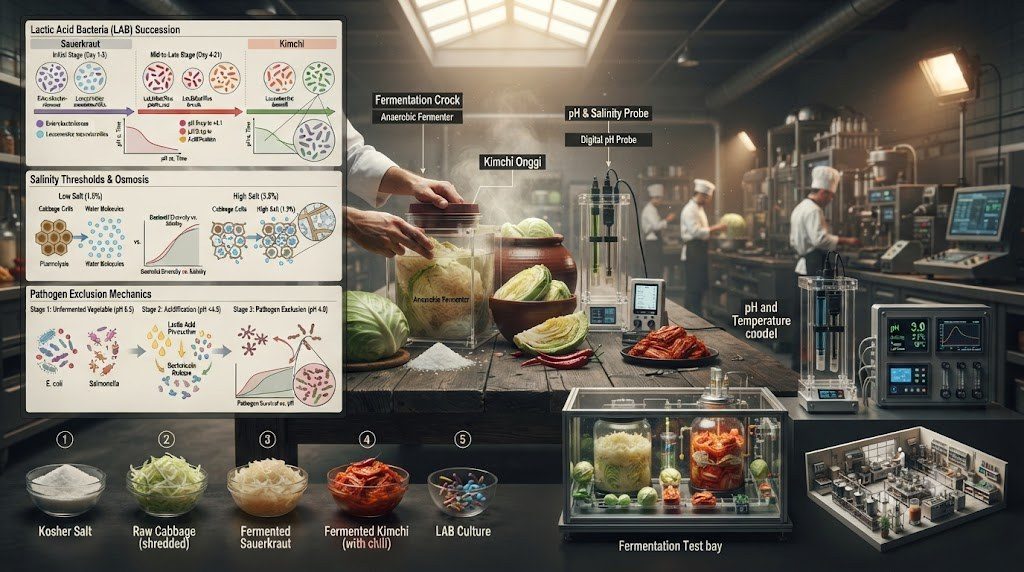
The wild surfaces of raw brassica vegetables (cabbage, radishes) harbor a chaotic consortium of millions of microorganisms, including soil bacteria, wild yeasts, molds, and pathogenic enterobacteria. When cabbage is shredded, salted, and packed anaerobically into a fermentation crock, a predictable three-stage bacterial succession unfolds:
1.1 Stage 1: Leuconostoc mesenteroides (The Initiation Specialist)
During the first 24 to 72 hours of fermentation:
- The environment is only mildly acidic (pH 6.5 to 5.5). Most bacteria cannot thrive, but Leuconostoc mesenteroides—a facultative anaerobic, heterofermentative coccus—initiates rapid growth.
- L. mesenteroides is uniquely tolerant of cold ambient temperatures (15°C to 18°C) and moderate salinity.
- It rapidly metabolizes plant sugars (glucose and fructose) via the Phosphoketolase Pathway, producing not just lactic acid, but also carbon dioxide ((\text{CO}_2)), ethanol, and acetic acid.
- The produced (\text{CO}_2) bubbles upward, purging remaining oxygen from the vessel and establishing strict anaerobiosis. Simultaneously, the rapid drop in pH below 5.0 suppresses undesirable spoilage microbes and molds.
1.2 Stage 2: Lactobacillus plantarum (The Primary Acid Engine)
As the pH drops below 4.5, L. mesenteroides exhausts its acid tolerance and dies off. The environment is now seized by Lactobacillus plantarum (recently reclassified as Lactiplantibacillus plantarum) and Lactobacillus brevis:
- L. plantarum is a rod-shaped, homofermentative and facultatively heterofermentative powerhouse that thrives in high-acid conditions.
- It metabolizes remaining hexose sugars directly into pure L- and D-lactic acid via the Embden-Meyerhof-Parnas (glycolytic) pathway with near-zero gas production.
- This drives the pH rapidly down into the critical food-safety threshold of pH 3.8 to 4.2.
1.3 Stage 3: Lactobacillus brevis and Pediococcus pentosaceus (The Acid Finishers)
In prolonged or warm fermentations, acid-tolerant species like Lactobacillus brevis and Pediococcus pentosaceus complete the fermentation cycle. They survive down to a blistering pH of 3.4 to 3.6, consuming trace pentose sugars and generating subtle aromatic esters that give aged kraut its sharp, complex, tangy finish.
2. Homofermentative vs. Heterofermentative Metabolism
The metabolic pathways utilized by LAB dictate the sensory and physical qualities of the fermented product:
2.1 Homofermentative Pathway (Pure Acid Output)
Homofermentative LAB convert 1 mole of glucose exclusively into 2 moles of lactic acid via standard glycolysis, yielding 2 ATP of biological energy:
$$\text{C}_6\text{H}_{12}\text{O}_6 \rightarrow 2\text{ CH}_3\text{CH(OH)COOH}$$
This pathway produces clean, sharp, focused sourness with zero gas bubbling. It is favored when firm texture and pure lactic bite are desired.
2.2 Heterofermentative Pathway (Complex Volatile Bouquet)
Heterofermentative LAB lack the glycolytic enzyme aldolase; they utilize the 6-phosphogluconate / phosphoketolase pathway to convert 1 mole of glucose into 1 mole of lactic acid, 1 mole of ethanol (or acetic acid), and 1 mole of (\text{CO}_2):
$$\text{C}_6\text{H}_{12}\text{O}_6 \rightarrow \text{Lactic Acid} + \text{Ethanol/Acetic Acid} + \text{CO}_2$$
This pathway is responsible for the effervescent carbonation, aromatic complexity, and mild vinegar-like sharpness found in authentic sparkling kimchi.
3. The Chemistry of Salinity: The 2.0% to 2.5% Equilibrium Golden Rule
Salt (Sodium Chloride, (\text{NaCl})) is not merely a seasoning agent in lacto-fermentation; it is a critical selective antimicrobial filter and cellular osmotic extractor.
3.1 Osmotic Pressure and Brine Generation
When dry salt is massaged into shredded cabbage, the high exterior solute concentration creates a steep osmotic gradient across the plant cell walls. Water rapidly diffuses out of the cabbage vacuoles to balance osmotic pressure, drawing out plant sugars, vitamins, and minerals to form a natural, nutrient-rich aqueous brine that completely submerges the vegetable mass.
3.2 Pathogen Exclusion via Water Activity ((a_w)) Depression
Harmful food-borne pathogens—most notably Clostridium botulinum, Escherichia coli, and Salmonella enterica—are exquisitely sensitive to salt concentrations. At an equilibrium salinity of 2.0% to 2.5% by total weight (vegetables + water), osmotic pressure disrupts the cell membranes of pathogenic bacteria, halting their cellular division. Lactic acid bacteria, by contrast, possess robust osmoregulatory transport mechanisms (accumulating compatible intracellular solutes like betaine and proline) that allow them to flourish in saline environments up to 6% to 8%.
4. Quantitative Lacto-Fermentation Matrix
| Fermentation Style | Salinity Formulation | Optimal Ambient Temp | Fermentation Duration | Key Microbiological Marker |
|---|---|---|---|---|
| Artisan Sauerkraut (Dry-Salted) | 2.2% to 2.5% of cabbage weight | 16°C – 20°C (60°F – 68°F) | 21 – 28 days | Slow, orderly transition from L. mesenteroides to L. plantarum; crisp texture. |
| Traditional Kimchi (Brined & Pasted) | Initial 10% brine soak, rinsed to ~2.0% final | 18°C (2 days) → 4°C (Onggi chill) | 14 – 60 days | Heterofermentative (\text{CO}_2) saturation; effervescent mouthfeel and umami depth. |
| Full-Sour Cucumber Pickles (Wet Brine) | 3.5% to 5.0% aqueous brine | 18°C – 22°C (64°F – 72°F) | 10 – 16 days | Tannin addition mandatory to block pectinase enzyme degradation. |
| Hot Pepper Mash (Hot Sauce Base) | 2.5% to 3.0% dry salt mash | 20°C – 24°C (68°F – 75°F) | 30 – 180 days | Capsaicin-tolerant LAB breakdown; deep esterification of pepper volatiles. |
5. The Pectinase Enzyme Problem: Why Pickles Go Soft and How to Prevent It
The most heartbreaking defect in vegetable lacto-fermentation is the loss of turgid, crunchy texture—resulting in limp, mushy, unappealing pickles. This degradation is biological:
- Plant cell walls are held together by a structural polysaccharide called pectin.
- Naturally present on cucumber blossoms and vegetable stems are native plant and fungal enzymes known as polygalacturonases (pectinases).
- These pectinases hydrolyze alpha-1,4-glycosidic bonds in pectin, dissolving the structural “glue” that keeps vegetables crunchy.
- The Fix (Tannins and Calcium Chloride): Adding botanical leaves rich in condensed tannins—such as oak leaves, grape leaves, horseradish leaves, or black tea bags—inhibits pectinase enzymes. The polyphenolic tannins bind to the catalytic active site of pectinase enzymes, rendering them permanently denatured. Additionally, adding 0.1% food-grade calcium chloride ((\text{CaCl}_2)) provides divalent calcium ions ((\text{Ca}^{2+})) that cross-link with pectin chains, creating a rigid calcium pectate mesh that preserves crispness for months.
6. Kahm Yeast vs. Toxic Mold Identification Protocols
Fermenters frequently encounter white surface films on top of the brine, triggering anxiety regarding mold toxicity. Distinguishing harmless wild yeasts from dangerous pathogenic fungi requires strict mycological criteria:
- Kahm Yeast (Aerobic Pellicle): Forms a paper-thin, translucent, flat, chalky-white or cream-colored geometric film on the liquid surface. It is formed by non-toxic wild aerobic yeasts (such as Pichia, Debaryomyces, or Candida) that consume lactic acid when exposed to oxygen. Kahm yeast is non-toxic, but it should be skimmed off with a sterile spoon because it reduces acidity and can impart stale, oxidized flavors.
- True Toxic Molds (Aspergillus, Penicillium, Mucor): Molds are filamentous, multi-cellular fungi that require direct atmospheric oxygen. They appear as fuzzy, raised, powdery colonies and frequently display pigmentation (blue, green, black, pink, or yellow). True molds produce dangerous mycotoxins. If fuzzy mold colonies appear on any fermented vegetable floating above the brine, the entire batch must be discarded immediately.
7. Frequently Asked Questions (FAQ) Regarding Lacto-Fermentation
Q1: Can table salt containing iodine or anti-caking agents be used for fermentation?
Answer: Avoid iodized table salt. While trace potassium iodide does not reliably halt bacterial fermentation, anti-caking additives (such as sodium aluminosilicate or yellow prussiate of soda) cause the fermentation brine to turn cloudy and leave an unappealing metallic aftertaste. Always use pure, additive-free salts: Coarse Kosher Salt, Pickling Salt, or Non-Mineral Fine Sea Salt. Because salt crystal grain size varies drastically between brands, always measure salt by weight (grams) on a digital scale, never by volume (spoons).
Q2: Why must vegetables remain 100% submerged beneath the brine level at all times?
Answer: Lactic acid bacteria are facultative anaerobes that flourish in zero-oxygen environments, whereas spoilage molds and putrefactive bacteria require atmospheric oxygen to survive. As long as vegetables are submerged completely beneath liquid brine, oxygen cannot contact the plant tissue. Any vegetable piece poking above the brine line becomes a landing strip for airborne mold spores. Always utilize fermentation glass weights, ceramic stones, or cabbage leaf caps to hold all solid plant matter securely beneath the surface.
Q3: Is there any risk of Clostridium botulinum in lacto-fermented sauerkraut or pickles?
Answer: Virtually zero, provided proper salinity and temperature protocols are followed. Clostridium botulinum spores cannot germinate or produce neurotoxin at a pH below 4.6. In a properly managed lacto-fermentation, LAB drive the pH down below 4.0 within 48 to 72 hours, completely paralyzing botulism before it can ever initiate growth. In over a century of modern public health tracking, there has never been a documented case of botulism in properly acidified lacto-fermented vegetables.
Q4: Why does kimchi sometimes become overly carbonated and fizzy?
Answer: Effervescence is a natural, highly prized hallmark of authentic kimchi. It is caused by the heterofermentative metabolism of Leuconostoc mesenteroides and Lactobacillus brevis, which generate carbon dioxide gas alongside lactic acid. When kimchi is sealed in airtight jars and kept cold, (\text{CO}_2) dissolves into the aqueous cabbage juices under pressure. Upon opening, the dissolved gas nucleates into refreshing, effervescent bubbles on the palate.
Q5: What is the optimal temperature range for fermenting sauerkraut at home?
Answer: The ideal temperature window is 16°C to 20°C (60°F to 68°F). Cool temperatures favor the slow, orderly succession of L. mesenteroides, which produces rich aromatic esters and preserves firm cabbage cell wall pectin. Fermenting at temperatures above 24°C (75°F) causes L. plantarum to rush ahead prematurely, producing harsh, unpleasantly acidic, soft, and sulfurous sauerkraut.
Q6: How long can a jar of finished lacto-fermented vegetables keep in the refrigerator?
Answer: Once the desired acidity is reached (typically pH 3.5 to 3.8), transferring the jar to a standard 4°C (39°F) refrigerator slows microbial metabolism by over 95%. Due to the high lactic acid concentration, low pH, and protective salinity, unopened jars of raw fermented sauerkraut and kimchi will remain safely edible, crisp, and probiotic-rich for 9 to 12 months.
Q7: Why is chlorinated municipal tap water detrimental to wet-brine fermentations?
Answer: Municipal tap water is treated with chlorine or chloramines specifically engineered to kill bacteria in municipal pipes. When used directly in fermentation brines, residual chlorine acts as a broad-spectrum sanitizer that kills the beneficial wild lactic acid bacteria residing on vegetable surfaces, resulting in sluggish fermentation or spoilage. Always use filtered water, distilled water, or boil municipal tap water for 15 minutes to off-gas volatile chlorine before cooling and preparing brines.
8. The Physics of Fermentation Airlocks and Carbon Dioxide Purge Chambers
Traditional fermentation vessels utilized water-sealed moats or weighted stones. In modern culinary laboratories, fermenters utilize mechanical three-piece S-bubble airlocks or specialized silicone burper lids. The engineering objective is to maintain a continuous one-way pressure release dynamic.
As Leuconostoc mesenteroides and heterofermentative LAB metabolize hexoses into carbon dioxide gas, the internal gas volume expands, building positive internal gauge pressure. Once pressure exceeds 0.2 psi, ( ext{CO}_2) pushes past the fluid barrier in the airlock and vents safely into the ambient air. Crucially, because carbon dioxide has a molar mass of 44 g/mol (substantially heavier than ambient atmospheric nitrogen at 28 g/mol and oxygen at 32 g/mol), it forms a dense, invisible, protective gas blanket directly over the liquid brine. This inert gas canopy starves surface mold spores of oxygen, guaranteeing safe, spoilage-free fermentation.
Q8: What is the scientific protocol for fermenting low-sugar vegetables like cucumbers or green beans?
Answer: Vegetables like pickling cucumbers, asparagus, and green beans contain lower natural sugar concentrations (approx. 1.5% to 2.5% sugar by weight) compared to sweet brassicas like cabbage (approx. 4.5% to 5.5% sugar). To ensure that lactic acid bacteria produce sufficient acid to drive pH safely below 4.0, experienced fermenters often add a small quantity of clean fermentable carbohydrates—such as a 1% addition of unrefined cane sugar, a slice of sweet organic apple, or a splash of active raw starter brine from a previous successful ferment—to kick-start bacterial acidogenesis.
9. Culinary Summary and The Mastery of Microbes
Lacto-fermentation is a brilliant biological partnership between human cooks and beneficial microbes. By respecting the physical laws of salinity, maintaining an anaerobic aqueous sanctuary, and honoring the temperature kinetics of bacterial succession, fermenters convert humble brassicas into shelf-stable, probiotic-rich gastronomic masterpieces that nourish both palate and microbiome.