Air Frying Thermodynamics: High-Velocity Convection Dynamics, Surface Dehydration, and Oil Reduction Science

Over the past decade, the rapid ascendancy of the Air Fryer has revolutionized residential and commercial small-appliance culinary technology. Marketed as a revolutionary health appliance capable of replicating the crisp texture of deep-fried foods with up to 80% less oil, the air fryer is often misunderstood by consumers as an entirely novel heating modality. In … Read more

Pan-Frying vs. Shallow Frying: Skillet Thermal Mass, Surface Fond Development, and Pan Sauce Emulsions

In culinary discourse, the terms pan-frying, shallow frying, and sautéing are frequently conflated, yet in thermodynamic and physical execution, they represent distinct cooking methodologies with radically different fluid dynamics, heat transfer coefficients, and surface flavor chemistry. While deep frying submerges food entirely within an isotropic bath of hot fat, pan-frying and shallow frying operate at … Read more

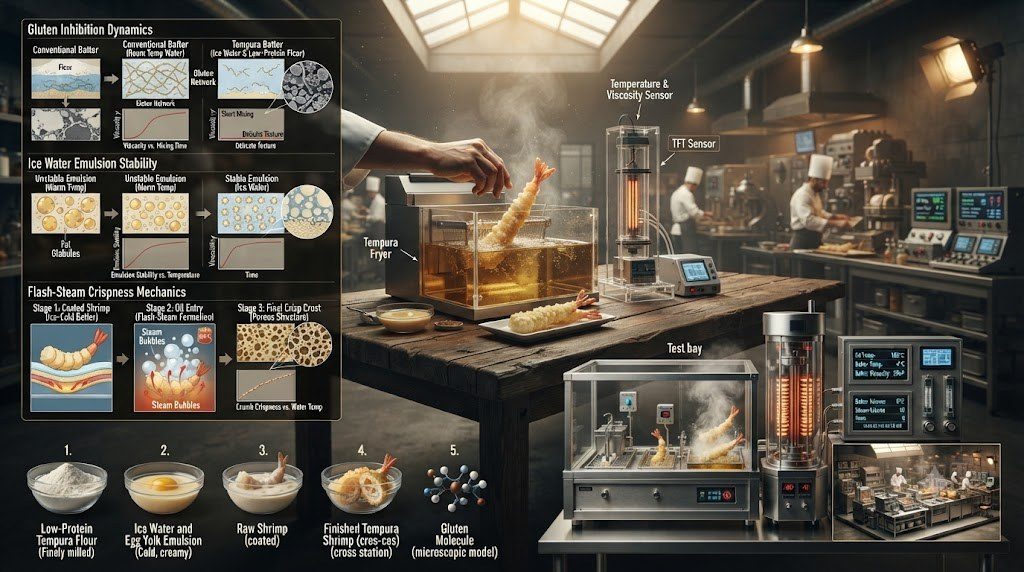
Authentic Tempura Batter Science: Gluten Inhibition, Ice Water Emulsions, and Flash-Steam Crispness

In the pantheon of global fried foods, traditional Japanese Tempura represents the absolute zenith of delicacy, lightness, and textural minimalism. Unlike heavy, thick Western beer-battered fish or dense Southern cornmeal crusts that encase food in an opaque structural armor, authentic Edomae tempura is characterized by an ethereal, semi-translucent, lace-like coating (the famous koromo). The fried … Read more

Deep Frying Oil Chemistry: Smoke Points, Triglyceride Degradation, Vapor Barriers, and Crispness Physics

Deep frying is frequently misunderstood as a crude, grease-heavy cooking method. In reality, when executed with scientific precision, deep frying is an extraordinary, high-efficiency dehydration and steam-cooking process. Submerging food into hot oil maintained between 165°C and 190°C (325°F to 375°F) utilizes liquid oil as a high-density thermal conduction medium—transferring thermal energy into food up … Read more