Rotisserie Spit-Roasting Science: Gyroscopic Self-Basting, Radiant Emissivity, and Uniform Heat Convection

From medieval castle hearths turning whole boars on iron spits to modern Parisian rotisseries roasting golden chickens and Middle Eastern vertical shawarma spits slicing tender seasoned lamb, Rotisserie Cooking (Spit-Roasting) represents one of the most mechanically elegant and thermodynamically superior methods of cooking meat known to culinary science. While traditional roasting in a static oven … Read more

Cedar Plank Grilling Mechanics: Steam-Wood Infusion, Thermal Buffering, and Delicate Seafood Mastery

Grilling delicate, moisture-rich proteins—most notably wild salmon fillets, Arctic char, sea scallops, and camembert cheese—presents an immediate physical challenge on an open barbecue grate. The intense, direct radiant heat of charcoal or gas burners easily exceeds 300°C (572°F), rapidly vaporizing delicate surface moisture, causing thin skin to weld irrevocably to metallic grill grates, and overcooking … Read more

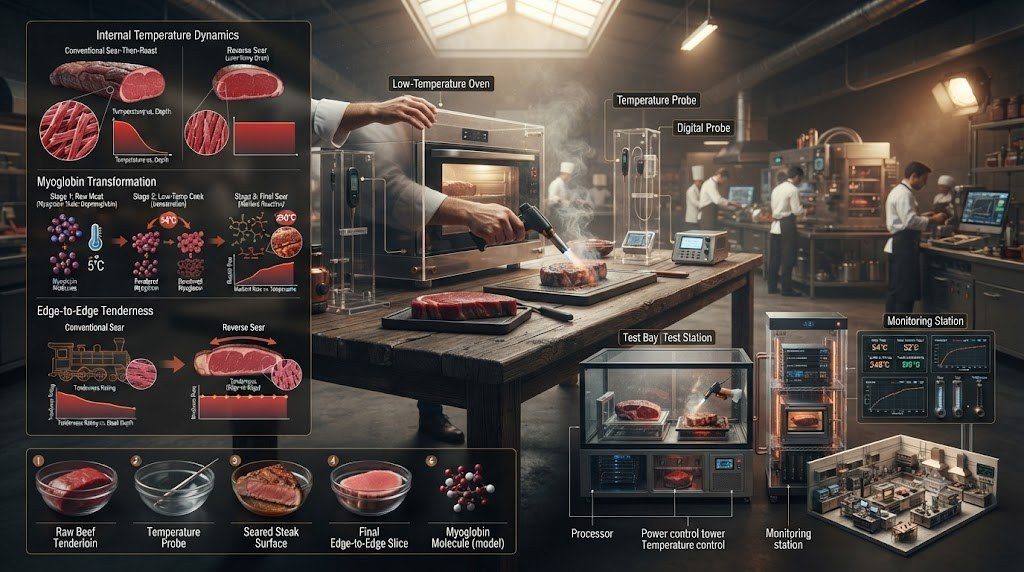
The Reverse Sear Technique: Internal Temperature Dynamics, Myoglobin Transformation, and Edge-to-Edge Tenderness

For more than a century, professional culinary textbooks and kitchen dogma instructed chefs to execute the “sear-and-bake” method: searing a raw thick-cut steak in a scorching-hot skillet or directly over blazing charcoal coals before transferring it to a moderate oven to finish cooking through. While this traditional technique works adequately for thin cuts, applying it … Read more

The Chemistry of Wood Smoke and Fire: Charcoal vs. Gas Thermodynamics, Maillard Reactions, and Barbecue Science

Live-fire grilling and low-and-slow barbecue represent humanity’s oldest cooking methodology, yet they remain among the most intricate arenas of culinary organic chemistry and thermodynamics. Cooking over fire is fundamentally distinct from cooking in a standard kitchen oven or on an electric stovetop. When meat is suspended over glowing coals, fragrant hardwood embers, or high-output gas … Read more