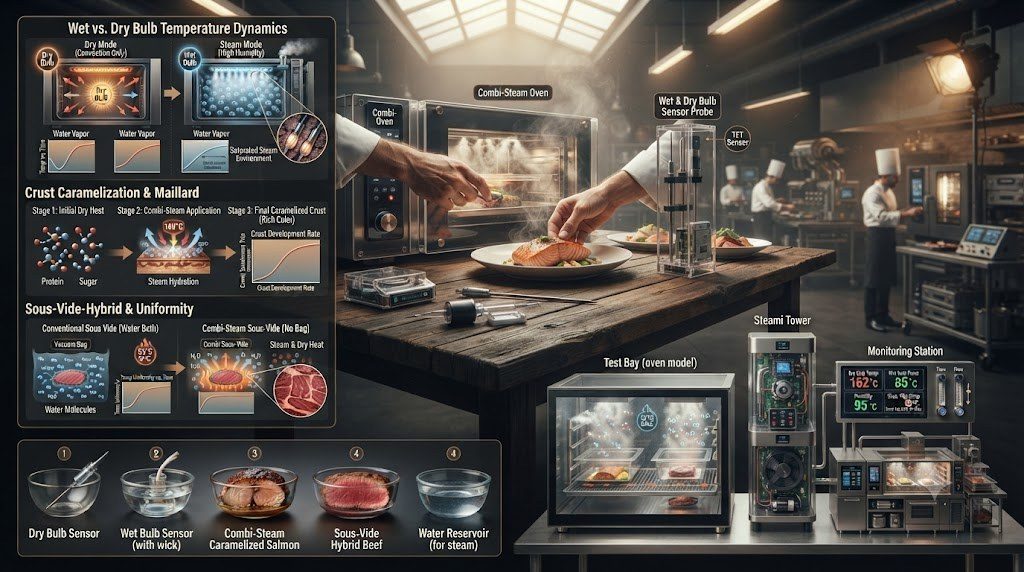
In modern professional gastronomy, few technological innovations have exerted as transformative an impact on kitchen engineering as the Combination Steam Oven (Combi-Oven). First pioneered in Germany by Rational in the late 1970s and now a staple in Michelin-starred establishments and cutting-edge culinary research laboratories, the combi-oven bridges the gap between convection baking, saturated steaming, and precision low-temperature sous-vide cookery.
Traditional ovens subject food to dry, moisture-stripping convective airflow, while conventional steamers immerse food in wet, unpressurized 100°C vapor that precludes any possibility of Maillard browning. A combi-oven achieves complete thermodynamic control by simultaneously regulating Dry Bulb Temperature, Wet Bulb Temperature, and Relative Humidity (0% to 100% RH). This exhaustive technical study analyzes the thermodynamic physics, fluid psychrometrics, and biochemical transformations governed by combi-steam technology, establishing a scientific guide to crust caramelization, moisture retention, and high-yield protein roasting.
1. Psychrometric Thermodynamics: Dry Bulb vs. Wet Bulb Dynamics
To understand the engineering precision of a combi-steam oven, one must master psychrometrics—the physical science of gas-vapor mixtures and atmospheric thermodynamics:
1.1 Dry Bulb Temperature ((T_{db}))
The Dry Bulb Temperature is the standard ambient thermal reading recorded by an ordinary thermometer suspended in the air chamber. It measures the sensible kinetic energy of the convective gas molecules circulating within the oven cavity, ranging from 30°C to 300°C.
1.2 Wet Bulb Temperature ((T_{wb})) and Latent Evaporative Cooling
The Wet Bulb Temperature represents the actual physical temperature experienced by the surface of moist, unsealed food. It is measured by a temperature sensor enveloped in a water-saturated porous wick subjected to high-velocity airflow:
- In bone-dry air (0% relative humidity), water evaporates violently from the wet surface. This phase change absorbs latent heat of vaporization (approx. 2,260 J/g), chilling the food surface significantly below the dry bulb reading. In a standard dry oven set to 150°C, a moist chicken breast’s surface temperature is suppressed down to 55°C–65°C by evaporative chilling, prolonging cooking times and siphoning away vital juices.
- In 100% relative humidity, the vapor pressure of the oven air matches the vapor pressure of water at that temperature. Evaporation halts completely. The wet bulb temperature equals the dry bulb temperature ((T_{wb} = T_{db})). The food surface cannot cool itself via evaporation, leading to immediate, ultra-rapid heat conduction via condensing steam.
1.3 The Psychrometric Chart and Microprocessor Climate Control
Inside a professional combi-oven, high-precision solid-state humidity sensors and optical steam generators monitor relative humidity dozens of times per second. By injecting micro-pulses of pressurized saturated steam or activating motorized dehumidification butterfly dampers, the onboard microprocessor maintains the exact psychrometric coordinate requested by the chef, unlocking unprecedented culinary control.
2. Crust Caramelization Physics: The Role of Steam in Artisan Baking
One of the most famous applications of combi-steam technology is in high-end artisan bread and pastry baking. Commercial bakery deck ovens utilize steam injection during the initial bake cycle to produce magnificent sourdough loaves and baguettes with blistering, glass-like crusts and explosive oven spring.
2.1 Phase 1: Steam Condensation and Oven Spring Maximization
During the first 5 to 8 minutes of bread baking:
- The combi-oven injects high-density steam at 230°C (450°F), maintaining 80% to 100% relative humidity.
- When this hot steam contacts the cold raw dough (at 20°C to 25°C), it instantly condenses into a continuous liquid water sheen across the exterior.
- This liquid sheen transfers colossal latent heat directly into the dough surface, driving rapid early gas expansion (carbon dioxide and trapped steam) inside the crumb—maximizing oven spring.
- Crucially, the moist water layer keeps the dough surface supple, elastic, and cool (pinned at the 100°C wet bulb barrier), preventing premature crust formation. The score lines (slashes) expand completely without tearing.
2.2 Phase 2: Starch Gelatinization and Dextrin Glazing
Simultaneously, the combination of hot steam and surface water causes raw starch granules on the dough surface to undergo full starch gelatinization. As amylose and amylopectin molecules swell and burst, they form a clear, viscous starch gel spread smoothly over the loaf. As baking transitions to the dry phase, these starches undergo thermal pyro-dextrinization, dehydrating into an ultra-thin, brittle, glassy shell that crackles upon cooling and produces a brilliant diamond-like sheen without requiring egg wash.
2.3 Phase 3: Dehumidification and Maillard Crust Development
At the 8-minute mark, the combi-oven automatically opens motorized exhaust dampers, purging 100% of internal humidity in seconds while maintaining dry convection heat at 220°C. With humidity eradicated, surface water flash-evaporates, and the dehydrated dextrinized skin rapidly surpasses 140°C, igniting complex Maillard reactions between wheat gluten amino acids and reducing sugars, producing a rich mahogany coloration, complex roasted alkylpyrazines, and a shatteringly crisp crust.
3. Protein Thermodynamics: Combi-Roasting vs. Sous-Vide Hybrids
In meat cookery, combi-steam ovens have revolutionized the preparation of large primal cuts—such as prime ribs, pork loins, and whole poultry—by blending the tenderness of sous-vide with the flavor of dry roasting.
3.1 Yield Loss Optimization (The 15% Savings)
In conventional dry convection roasting, large beef roasts experience between 20% and 30% total yield loss due to aggressive evaporative moisture depletion and fat rendering. In a combi-oven operating at 30% to 40% controlled humidity, evaporative vapor pressure is buffered. Intracellular muscle water is prevented from escaping into the atmosphere. Total cooking shrink loss drops to under 8% to 12%, preserving succulent tenderness while yielding substantially higher edible portion weight.
3.2 Sous-Vide Without the Plastic Bag
Because modern combi-ovens can regulate wet-bulb steam temperatures with single-degree precision between 45°C and 90°C, chefs can execute “bagless sous-vide”:
- Placing salmon fillets or pork loins into a combi-oven set to 54°C (129°F) at 100% humidity creates an isotropic saturated steam environment that matches the heat transfer dynamics of a circulating water bath.
- Heat diffuses into the protein with identical gentleness without requiring single-use plastic vacuum pouches, slashing plastic waste and labor prep times while achieving flawless edge-to-edge medium-rare doneness.
4. Quantitative Combi-Steam Operational Matrix
| Culinary Application | Dry Bulb Temp (°C / °F) | Relative Humidity (%) | Fan Airspeed | Thermodynamic & Textural Goal |
|---|---|---|---|---|
| Artisan Sourdough Loaf (Phase 1) | 230°C (446°F) | 100% Steam Injection | Low (Gentle) | Maximum oven spring, starch gelatinization, suppression of premature crust. |
| Artisan Sourdough Loaf (Phase 2) | 210°C (410°F) | 0% (Full Vent Open) | Medium / High | Rapid flash-evaporation, Maillard browning, creation of brittle glassy crust. |
| Whole Roast Chicken (Dual Phase) | 165°C → 215°C | 40% RH → 10% RH | High | Moisture retention in breast meat followed by blistered, shatteringly crisp skin. |
| Delicate Egg Custard / Crème Brûlée | 85°C (185°F) | 100% Pure Steam | Low | Isothermal coagulation of egg proteins without surface skinning or water baths. |
5. Boiler-Based vs. Boilerless Steam Generation Engineering
In modern combi-oven design, two competing thermodynamic architectures exist for generating steam:
- External Steam Generator (Boiler System): Features a dedicated, insulated flash boiler outside the cooking chamber that generates true pressurized saturated steam at 100°C. When called for, pure dry-saturated steam is injected into the cavity. Advantages: Instantaneous steam saturation, flawless low-temperature precision (30°C to 95°C), and zero mineral scaling inside the cooking cabinet. Preferred in high-volume bakeries and delicate pastry institutions.
- Direct Injection (Boilerless System): Atomizes cold municipal water directly through micro-nozzles onto the glowing electrical heating coils or gas heat exchangers circulating behind the high-RPM convection fan. Advantages: More compact footprint, lower initial capital cost, and instantaneous response during high-temperature roasting. However, it requires rigorous water filtration to prevent calcium carbonate scale buildup on heating elements.
6. Multi-Stage Delta-T ((\Delta T)) Cooking Kinetics
One of the most mathematically sophisticated functions of modern combi-ovens is (\Delta T) (Delta-T) Roasting. In conventional cooking, the oven is set to a fixed temperature (e.g., 150°C), resulting in a massive thermal differential between the cold meat core (20°C) and the oven air, creating a wide, overcooked gray outer ring.
In (\Delta T) cooking, a multi-point core probe tracks the internal meat core temperature ((T_{\text{core}})). The oven’s computer continuously adjusts the cavity air temperature ((T_{\text{cavity}})) to maintain a fixed, constant mathematical differential: (T_{\text{cavity}} = T_{\text{core}} + \Delta T) (typically (\Delta T = 20^{\circ}\text{C} \text{ to } 30^{\circ}\text{C})). As the meat warms from 20°C to 54°C, the oven temperature rises synchronously from 50°C up to 84°C. This ultra-gentle heat flux virtually eliminates moisture loss, melting collagen slowly while delivering 100% edge-to-edge pink perfection across massive beef ribs and whole hams.
7. Frequently Asked Questions (FAQ) Regarding Combi-Steam Technology
Q1: Why is water filtration and reverse osmosis mandatory for commercial combi-ovens?
Answer: Water contains dissolved mineral salts, primarily calcium, magnesium, and chloride ions. When municipal tap water evaporates into steam inside a 200°C combi-oven, dissolved minerals precipitate out as hard calcium carbonate limescale. Limescale coats heating elements, acting as an insulating barrier that causes heating coils to overheat and burn out. Furthermore, free chloride ions attack austenitic stainless steel, causing severe pitting corrosion and stress corrosion cracking. Commercial kitchens must install dedicated ion-exchange water softeners or reverse osmosis (RO) filtration systems to preserve equipment longevity.
Q2: Can delicate items like choux pastry (profiteroles) be baked using steam injection?
Answer: Yes, with magnificent results. Choux pastry relies on the rapid expansion of internal water into steam to hollow out the interior shell. Injecting a brief 2-minute pulse of 100% steam at the beginning of the bake delays surface egg-crust coagulation, allowing the choux puffs to expand to maximum spherical volume. The oven is then immediately shifted to 0% humidity with exhaust dampers wide open to dry out the walls into crisp, golden, hollow shells.
Q3: How does a combi-oven prevent flavor transfer when cooking fish and pastries simultaneously?
Answer: In standard ovens, volatile aromas cross-contaminate foods through stagnant air. In a combi-oven, high-velocity convective airflow paired with continuous steam condensation creates a self-cleaning dynamic. Volatile odor compounds dissolve in microscopic condensing steam droplets, which are swept across the ceiling and channeled directly down the internal drainage drainpipe before they can deposit onto adjacent food pans.
Q4: Why does combi-steamed bacon or pork belly cook faster while retaining greater volume?
Answer: In dry convection, the surface of pork belly dehydrates into a tough, impermeable leather that traps rendering fat inside while shrinking the overall slab. In a combi-oven running at 130°C and 50% relative humidity, the humid vapor keeps the outer rind soft and conductive. Latent heat accelerates internal collagen breakdown into gelatin, while rendering excess intramuscular fat smoothly into the pan, yielding pork belly that is extraordinarily tender, plump, and succulent.
Q5: What is the primary difference between residential steam ovens and commercial combi-ovens?
Answer: Residential steam ovens generally use direct injection or small water reservoirs with slower evaporation rates, often limiting steam output above 100°C. Commercial units feature plumbed industrial water lines, heavy high-pressure boiler manifolds, motorized multi-directional high-CFM fans, and automated acid wash chemical descaling cycles, allowing continuous heavy-duty service across three shifts.
Q6: How does steam injection prevent “bread blowout” during artisan baking?
Answer: “Bread blowout” occurs when the exterior crust of a loaf dries and hardens before the internal gases have finished expanding, forcing steam to violently rupture through the bottom or weak side seams. Saturated steam injection keeps the dough skin soft, pliable, and extensible for the first 6 minutes, allowing the scored incisions to open smoothly into an iconic, raised artisan “ear” without structural blowout.
Q7: Can a combi-oven be used to dehydrate fruits and produce jerky?
Answer: Yes. Modern combi-ovens feature a specialized Dehumidification Mode where the steam boiler is completely deactivated, the motorized exhaust dampers are locked at 100% open, and the convective fan runs at low speed at 50°C to 65°C. This continuously purges evaporating moisture from the chamber, serving as an industrial food dehydrator that dries apple slices, herbs, and cured jerky with extreme uniformity.
8. Energy Efficiency and Heat Recovery Systems in Commercial Combi-Ovens
Modern commercial kitchens operate under stringent energy consumption mandates. Traditional convection ovens continuously dump vast volumes of heated kitchen air through passive roof flues, driving massive HVAC electrical loads. Advanced combi-ovens incorporate sophisticated plate-fin heat exchanger manifolds and exhaust vapor condensing systems.
When high-temperature steam and convective air are vented during moisture purge cycles, the outgoing vapor passes across a counter-flow titanium heat exchanger. Cold incoming municipal water bound for the steam boiler absorbs this waste heat, pre-heating the boiler feed water from 15°C up to 65°C using zero electrical energy. Simultaneously, the condenser liquefies waste steam into water before it enters kitchen ductwork, reducing kitchen radiant heat loads by up to 40% and slashing total operational utility overhead.
Q8: How does atmospheric pressure compensation function in combi-ovens at high altitude?
Answer: At elevated altitudes (such as Denver, Mexico City, or Bogotá), lower barometric pressure suppresses the boiling point of open water below 100°C. Professional combi-ovens feature integrated piezo-resistive barometric pressure sensors that continuously gauge local atmospheric pressure. The digital control unit automatically recalibrates the 100% steam saturation point and adjusts boiling chamber pressure, ensuring that steam temperature curves match exact sea-level psychrometric formulas regardless of kitchen geographical elevation.
9. Culinary Summary and The Future of Precision Gastronomy
The combination steam oven represents the ultimate synthesis of thermodynamics, fluid mechanics, and food chemistry. By mastering the delicate balance between dry bulb temperature and wet bulb humidity, culinary professionals unlock complete authority over moisture retention, texture development, and flavor generation—elevating cooking from guesswork into an exact and repeatable science.