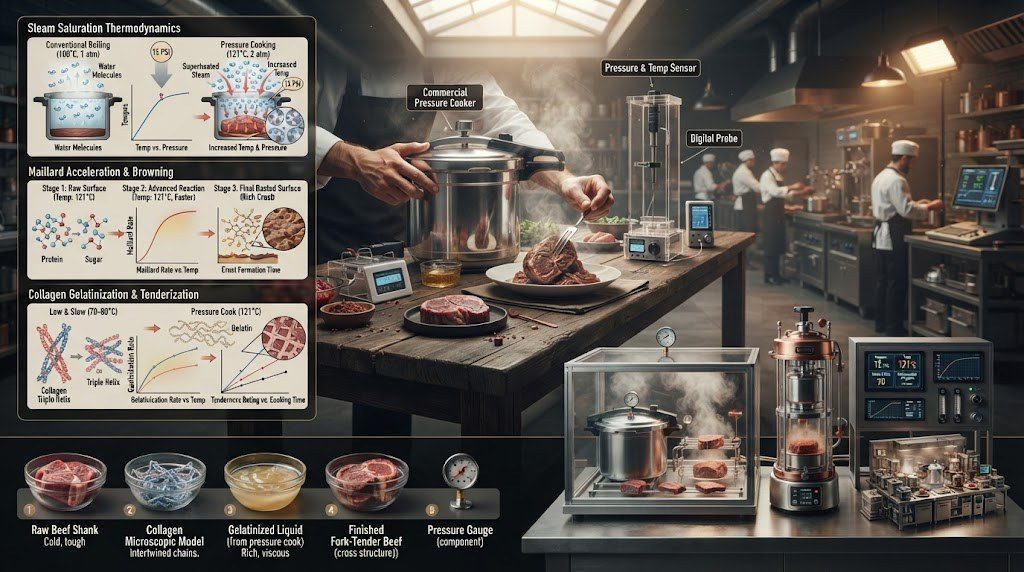
In the physical universe of cooking, the maximum temperature of liquid water is strictly dictated by local ambient atmospheric pressure. At standard sea-level barometric pressure (1 atmosphere, or 101.3 kPa), water boils at 100°C (212°F). No matter how intensely you crank up the gas flame beneath an open stockpot, the boiling liquid water cannot exceed 100°C; all excess thermal energy is consumed by the latent heat of vaporization as steam escapes into the kitchen. To cook faster and transform tough cuts of meat in record time, culinary physics requires altering the barometric boundary.
The modern Hermetically Sealed Pressure Cooker (and its digital electric counterpart, the multicooker) operates on this exact thermodynamic principle. By trapping evaporating steam within an airtight, reinforced vessel, the pressure cooker elevates internal cooking temperatures up to 121°C (250°F). This temperature surge accelerates biochemical reaction kinetics exponentially. This technical treatise explores the physical thermodynamics, chemical reaction pathways, and meat biochemistry of pressure cooking—including the Clausius-Clapeyron relation, accelerated Maillard browning, and rapid collagen gelatinization.
1. The Thermodynamics of High Pressure: The Clausius-Clapeyron Relation
The operating physics of a pressure cooker is mathematically governed by the Clausius-Clapeyron Equation, which describes the non-linear relationship between pressure and the phase-transition boiling point of liquids:
$$\ln\left(\frac{P_2}{P_1}\right) = -\frac{\Delta H_{\text{vap}}}{R} \left(\frac{1}{T_2} – \frac{1}{T_1}\right)$$
1.1 Standard Pressure Ratings and Temperature Curves
In standard kitchen pressure cookers, internal pressure is measured in pounds per square inch (psi) above ambient atmospheric pressure (termed “gauge pressure”):
- Standard Stove-Top Pressure Cookers (15 psi / 103 kPa gauge): Operates at an absolute pressure of approx. 2 atmospheres. At 15 psi, the boiling point of water is forced upward from 100°C to 121°C (250°F).
- Electric Multicookers / Instant Pots (10.1 to 11.6 psi / 70 to 80 kPa gauge): Operates at slightly lower pressure for consumer electronic safety margins, achieving internal temperatures of 115°C to 118°C (239°F to 244°F).
1.2 The Arrhenius Rate Acceleration Law
Why does an increase of just 21°C (from 100°C to 121°C) reduce cooking times by up to 70%? This phenomenon is explained by the Arrhenius Equation of Chemical Kinetics, which dictates that the rate constant ((k)) of chemical reactions scales exponentially with absolute temperature:
$$k = A \cdot e^{-\frac{E_a}{R T}}$$
As a foundational rule of thumb in physical chemistry (the (Q_{10}) temperature coefficient), for every 10°C increase in temperature, chemical reaction rates approximately double. Raising the cooking temperature from 100°C to 121°C represents two consecutive 10°C doublings: reactions proceed roughly four times faster. Consequently, a beef bone broth or braised chuck roast that requires 4 hours of gentle simmering in an open Dutch oven reaches the exact same stage of biochemical doneness in just 45 to 60 minutes inside a 15-psi pressure cooker.
2. Meat Biochemistry: High-Speed Collagen Hydrolysis into Gelatin
Tough, inexpensive cuts of meat—such as beef shank, brisket, chuck roast, and pork shoulder—are rich in dense sheets of Type I Collagen, an insoluble fibrous structural protein composed of tightly wound triple-helix peptide chains.
2.1 The Hydrolysis Mechanism
To make tough meat tender, this rigid collagen must undergo thermal hydrolysis: water molecules must cleave the covalent and hydrogen bonds binding the triple-helices together, melting the tough fibers into soluble, luxurious, liquid gelatin:
- At 60°C (140°F), collagen begins to shrink and contract, expelling water and toughening the meat.
- At 75°C to 85°C (167°F to 185°F) in a conventional simmer, collagen begins slowly unraveling into gelatin, but the process takes hours.
- Inside a 121°C pressure cooker, the massive thermal kinetic energy causes rapid, aggressive cleavage of collagen peptide bonds. The tough connective tissues melt into liquid gelatin in under an hour, bathing the muscle fibers in rich, mouth-coating umami while preserving structural integrity.
3. Flavor Chemistry: Maillard Reactions Under Saturated Steam
A widespread culinary misconception claims that Maillard browning cannot occur inside a pressure cooker because the environment is saturated with moisture. In open cooking, moisture does prevent browning because evaporative cooling pins the surface temperature at 100°C. However, inside a 121°C pressure vessel, the rules change completely.
3.1 The 121°C Maillard Threshold
The Maillard reaction between reducing sugars and free amino acids begins sluggishly around 120°C and accelerates dramatically above 140°C. In an open pot, wet food never passes 100°C. Inside a 15-psi pressure cooker, the boiling liquid itself reaches 121°C. At this temperature, slow Maillard reactions occur directly within the aqueous phase, generating rich heterocyclic aroma compounds without surface burning.
3.2 The Alkaline Maillard Trick (Baking Soda Acceleration)
Modern modernist chefs (such as Nathan Myhrvold and Heston Blumenthal) exploit this thermodynamic sweet spot by using baking soda (sodium bicarbonate) to create pressure-cooked caramelized purées (e.g., caramelized carrot soup or banana purée):
- Maillard reactions are heavily base-catalyzed; alkaline environments deprotonate amino acid amine groups ((-\text{NH}_3^+ \rightarrow -\text{NH}_2)), making them nucleophilic and reactive with sugars.
- Adding just 0.25% to 0.5% baking soda to carrots or onions raises the pH from acidic (5.5) to slightly alkaline (7.5–8.0).
- Under 15 psi at 121°C for 20 minutes, the vegetables undergo profound, uniform, deep-amber caramelization and Maillard browning throughout their entire mass without a single drop of added fat or surface scorching.
4. Fluid Mechanics: Depressurization Physics (Natural vs. Quick Release)
The most critical operational phase of pressure cooking occurs at the end of the cook cycle: Depressurization. How pressure is released fundamentally alters food texture and safety:
4.1 Natural Release (Gentle Conductive Cooling)
In natural release, the heat source is turned off and the vessel is left undisturbed for 15 to 25 minutes. Heat slowly dissipates into the surrounding kitchen air, gradually lowering internal steam temperature and pressure back to atmospheric equilibrium. Essential for: Large roasts, stews, bone broths, and dry beans. Because internal pressure drops gently, liquid inside the meat cells does not violently boil, preserving tenderness and preventing broth from becoming cloudy.
4.2 Quick Release (Explosive Cavitation and Boiling)
In quick release, the safety valve is manually opened, venting 15-psi steam into the room in seconds. While fast, this triggers extreme physical consequences: As pressure drops instantly, the super-heated 121°C liquid inside the pot finds itself far above the new 100°C boiling point, causing instantaneous, violent flash-boiling (cavitation) throughout the entire liquid volume. If applied to delicate meats, this explosive internal boiling violently ruptures muscle cell walls, squeezing out internal juices and leaving meat chalky and tough. Furthermore, starchy beans or soups will foam violently, spraying scalding liquid through the vent valve. Quick release should ONLY be used for: Tender vegetables (broccoli, squash), delicate root vegetables, or pasta dishes where stopping cooking instantly is required to prevent mushiness.
5. Aqueous Phase Extraction Kinetics: High-Yield Umami Solubilization
Beyond collagen gelatinization, cooking at 121°C inside a sealed pressure cooker accelerates the cellular extraction of savory intracellular ribonucleotides and amino acids. In poultry, veal, and mushroom stocks, two specific biomolecules act synergistically with free glutamic acid to create explosive umami sensations: Inosine Monophosphate (IMP) from muscle tissue and Guanosine Monophosphate (GMP) from fungi.
Under conventional simmering at 95°C, extracting these nucleotide monoesters from dense cartilage, marrow cavities, and cell walls requires 8 to 12 hours of prolonged boiling. Inside a 15-psi pressure cooker, the high thermal saturation and vapor density cause rapid cellular disruption, achieving complete extraction of IMP and GMP in just 60 to 75 minutes, yielding broths with significantly higher sensory richness and mouth-coating viscosity.
6. Thermodynamic Venting Dynamics: Saturated Steam vs. Liquid Entrainment
The fluid flow of steam exiting a pressure cooker during manual release is governed by supersonic choked nozzle flow dynamics. When the release valve is opened, high-pressure steam rushes across a steep pressure gradient into atmospheric air at velocities exceeding 300 m/s. If the fluid phase inside the pot contains dissolved starches or emulsified fats, the rapid decompression creates intense interfacial shear, producing a fine aerosol mist of scalding broth. Allowing 10 to 15 minutes of natural cooling reduces internal gauge pressure below 3 psi, preventing liquid entrainment and safeguarding kitchen safety.
7. Quantitative Pressure Cooking Master Matrix
| Food Item / Cut | Pressure Level | Cook Time (at pressure) | Depressurization Method | Biochemical & Culinary Outcome |
|---|---|---|---|---|
| Beef Short Ribs / Chuck Roast (1.5 kg) | High (15 psi / 121°C) | 45 – 55 min | Natural Release (20 min) | 100% collagen hydrolysis into silky gelatin; succulent, fork-tender pull. |
| Unsoaked Dry Chickpeas / Black Beans | High (15 psi / 121°C) | 30 – 35 min | Natural Release (15 min) | Complete pectin breakdown; ultra-creamy interior crumb with intact skins. |
| Rich Veal / Poultry Bone Broth | High (15 psi / 121°C) | 60 – 90 min | Natural Release (25 min) | Maximum extraction of osseous minerals, collagen, and glutamates; crystal clarity. |
| Artichokes & Dense Root Vegetables | High (15 psi / 121°C) | 8 – 12 min | Quick Release | Rapid hemicellulose softening without leaching water-soluble vitamins into broth. |
8. Frequently Asked Questions (FAQ) Regarding Pressure Cooking
Q1: Why do bone broths cooked in a pressure cooker remain so remarkably crystal-clear?
Answer: In an open stockpot, boiling liquid undergoes vigorous convective churning, tumbling bones and meat chunks against one another. This mechanical churning emulsifies rendered animal fats and particulate proteins into the water, creating a cloudy, greasy stock. Inside a pressurized vessel at 121°C, the liquid is maintained at thermodynamic saturation; it does not actively boil or churn while under steady pressure. Heat transfer occurs quietly via conduction, allowing heavy proteins and impurities to settle quietly without fat emulsification, yielding a broth of diamond-like clarity.
Q2: Can pressure cookers safely be used for canning low-acid foods (vegetables and meats)?
Answer: Only certified Pressure Canners (large heavy-gauge vessels with calibrated pressure dial gauges capable of holding 15 psi continuously) can be used for low-acid canning. Standard digital electric pressure cookers (like Instant Pots) do NOT sustain the exact 121°C thermal threshold throughout their entire volume required to eradicate dormant spores of Clostridium botulinum. Boiling-water baths only reach 100°C, which kills vegetative bacteria but leaves botulism spores intact.
Q3: Why must dairy products and thick starches (cornstarch/roux) never be added under pressure?
Answer: Adding dairy (milk, heavy cream, cheese) or thick starch slurries before pressurizing causes two severe failures: First, milk proteins (casein) curdle instantly under 121°C heat and acidic meat juices into grainy, separated curds. Second, thick viscous gravies cannot conduct heat rapidly to the bottom of the pot, causing starches to scorch against the high-heat bottom element, triggering appliance “BURN” error shutoffs. Always pressure cook with a thin water-based liquid, and stir in creams or starch thickeners after releasing pressure.
Q4: How does high-altitude cooking impact pressure cooker performance?
Answer: Because atmospheric pressure drops as altitude increases (approx. 1 psi drop per 2,000 feet), open water boils at significantly lower temperatures (e.g., 93°C at 2,000 meters in Denver). While pressure cookers partially compensate by regulating gauge pressure against ambient air, stove-top spring-valve models will achieve slightly lower internal absolute temperatures. As a standard engineering correction, increase pressure cooking times by 5% for every 1,000 feet above 2,000 feet elevation.
Q5: What is the primary safety protocol if the pressure relief valve begins violently spewing liquid?
Answer: If frothing liquid or food erupts from the steam valve during quick release, the pot was likely overfilled (exceeding the recommended 2/3 maximum volume, or 1/2 for expanding beans) or depressurized too violently. Immediately close the release valve and allow the unit to transition to Natural Release. Never force open a pressure cooker lid while the pin or locking mechanism is engaged.
Q6: Why is searing meat in the cooker before pressurizing critical for flavor development?
Answer: While the 121°C steam environment facilitates mild aqueous Maillard reactions, it cannot produce the intense, pyrolyzed, roasted crust achieved at 180°C–200°C. Searing meat cubes or bone cuts using the “Sauté” function in hot oil beforehand develops deep caramelized surface crusts and rich fond. When pressurized, the steam dissolves this fond into the liquid, multiplying the savory depth of the final dish tenfold.
Q7: Why does cooking dried legumes in a pressure cooker eliminate the toxic phytohaemagglutinin lectin completely?
Answer: Raw kidney beans and many dry legumes contain high concentrations of phytohaemagglutinin, a toxic plant lectin that causes severe gastrointestinal distress if undercooked. Phytohaemagglutinin is relatively heat-stable and can survive gentle simmering at 80°C in slow cookers, which actually increases toxicity. Inside a 15-psi pressure cooker at 121°C, the intense thermal energy completely denatures the globular protein structure of the lectin within 15 minutes, rendering the beans 100% chemically non-toxic, creamy, and digestible.
9. Culinary Summary and The Mastery of Pressure
Pressure cooking is one of the crowning achievements of thermodynamic application in the culinary arts. By harnessing the Clausius-Clapeyron relation to transcend the 100°C boiling barrier, chefs and home cooks slash cooking durations, melt tough collagen into rich gelatin, and extract extraordinary depth of flavor while preserving maximum nutritional vitality.