While bread baking relies on the development of an elastic, tenacious, three-dimensional gluten matrix to trap gas, cake baking is governed by the exact opposite structural objective: the strategic suppression and tenderization of gluten. A flawless cake—whether a towering multi-tier wedding cake, a tender sponge, or an ethereal chiffon—requires a delicate, velvety, moist crumb that holds its shape under gravity while melting luxuriously on the palate. Achieving this harmonious balance is a sophisticated exercise in physical chemistry, emulsion thermodynamics, fat crystallization, and chemical leavening kinetics.
This authoritative technical guide examines the molecular science of cake batters. It covers the four fundamental culinary building blocks (tougheners, tenderizers, moisteners, and driers), investigates emulsion stabilization in the creaming method, analyzes chemical leavening reactions (monocalcium phosphate vs. sodium aluminum sulfate), evaluates starch gelatinization and protein coagulation thresholds, and provides troubleshooting frameworks for structural collapse and tunneling.
1. The Four Molecular Forces of Cake Formulation
In food chemistry, cake formulation is governed by the Rule of Balanced Balances, categorizing all ingredients into four opposing molecular forces:
1.1 Tougheners (Structure Builders)
Tougheners supply the structural proteins and polymers that form the rigid cell walls of the baked crumb:
- Flour Proteins (Glutenin and Gliadin): Form a delicate, extensible protein web upon hydration and heating. Low-protein, chlorinated Cake Flour (7% to 8% protein) is specified to minimize excessive toughness.
- Egg White Proteins (Albumin): Ovalbumin, conalbumin, and ovomucoid denature and coagulate between 60°C and 85°C, providing structural scaffolding that supports the expanded cake volume.
1.2 Tenderizers (Structure Weakners)
Tenderizers counteract tougheners by physically or chemically interfering with gluten cross-linking and protein coagulation:
- Fats (Butter, Shortening, Oil): Coat flour protein particles in a hydrophobic lipid barrier (shortening the gluten strands, hence the name “shortening”), physically preventing water from hydrating glutenin and gliadin.
- Sugars (Sucrose): Highly hygroscopic; sugar molecules aggressively bind water molecules, starving flour proteins of the moisture required to form gluten. Furthermore, sugar elevates the thermal coagulation temperature of egg proteins, allowing the cake to expand larger before setting.
1.3 Moisteners vs. Driers
- Moisteners (Water, Liquid Milk, Whole Eggs): Supply the aqueous medium necessary to dissolve sugars, hydrate starches, and generate steam leavening.
- Driers (Flour Starches, Cocoa Powder, Milk Powder Solids): Absorb free moisture during mixing and baking, stabilizing the batter viscosity. Cocoa powder is an aggressive drier, requiring formula adjustments in liquid to prevent parched, crumbly textures.
2. Batter Emulsion Thermodynamics: The Creaming Method Physics
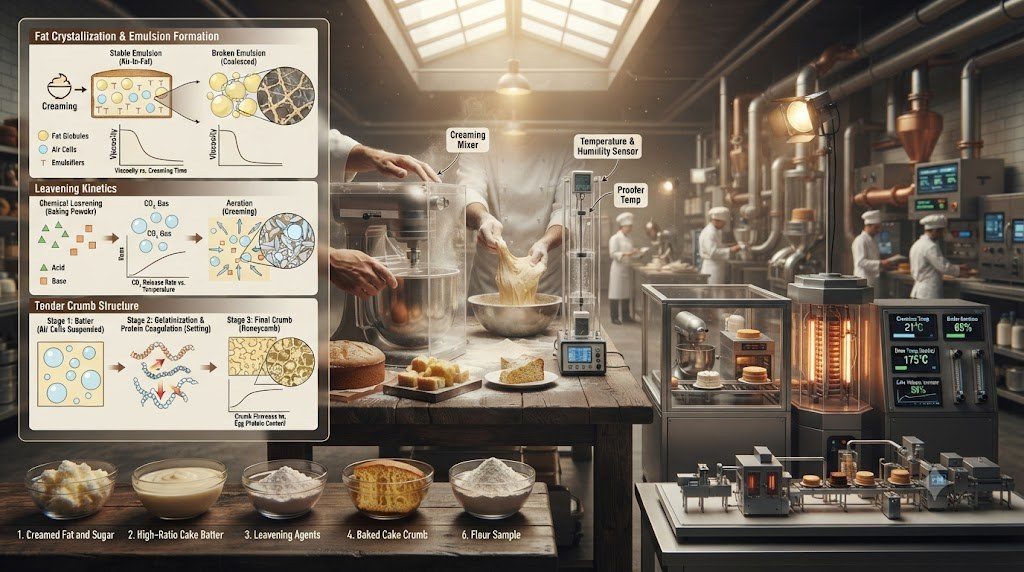
A cake batter is fundamentally a complex, multi-phase water-in-oil emulsion transitioning into an oil-in-water emulsion, containing suspended gas bubbles, dissolved sugar crystals, and dispersed starch granules. In the classical Creaming Method, the mechanical beating of solid plastic fat with granulated sugar crystals creates the aerated foundation of the cake.
The Aeration Mechanics of Fat Crystallization
When solid butter or shortening is beaten with granulated sucrose at 18°C to 21°C (65°F to 70°F), the sharp, faceted edges of the sugar crystals act as microscopic mechanical plows. As crystals drag through the plastic fat matrix, they carve out millions of tiny pockets of air. The surface-active monoglycerides and phospholipids naturally present in dairy butter stabilize these micro-bubbles, converting the fat into a light, pale, foamy mass.
Crucial Chemical Rule: Chemical leaveners (baking powder and baking soda) cannot create new air bubbles; they can only expand existing air pockets previously created during mechanical creaming. If creaming is rushed or executed with melted fat, the cake will emerge dense and flat regardless of how much baking powder is added.
Emulsion Breakdown (Curdling) and Lecithin Protection
Once fat and sugar are aerated, eggs are incorporated. Eggs are approximately 75% water. Adding large volumes of cold aqueous liquid to a fat matrix creates intense interfacial tension that threatens to break the emulsion (curdling / breaking):
- If eggs are added too quickly or too cold (< 15°C), the fat solidifies into greasy curds suspended in watery liquid. The trapped micro-bubbles coalesce into giant pockets and escape, destroying the cake's volume.
- The Fix: Eggs must be at room temperature (20°C) and beaten in gradually. Egg yolk lecithin—a powerful natural amphiphilic phospholipid containing a hydrophilic phosphate head and lipophilic fatty acid tails—aligns along the water-fat interface, slashing surface tension and stabilizing a velvety, micro-emulsified batter.
3. Chemical Leavening Kinetics: Single vs. Double-Acting Baking Powders
While biological yeast fermentation takes hours, chemical leavening reactions generate carbon dioxide ((\text{CO}_2)) within minutes through acid-base neutralization reactions:
\text{NaHCO}_3 \text{ (Baking Soda)} + \text{H}^+ \text{ (Acid Donor)} \rightarrow \text{Na}^+ + \text{H}_2\text{O} + \text{CO}_2\text{(g)}
3.1 Baking Soda (Sodium Bicarbonate)
Pure sodium bicarbonate requires an external food acid (such as buttermilk, sour cream, lemon juice, or natural cocoa powder) to react. If baking soda is added in excess without sufficient acid to neutralize it, unreacted bicarbonate thermally decomposes into Sodium Carbonate ((\text{Na}_2\text{CO}_3)). Sodium carbonate creates a bitter, metallic, soapy taste, turns white cakes into an unsightly greenish-yellow, and weakens crumb structure excessively.
3.2 Double-Acting Baking Powder: Two-Stage Leavening Kinetics
Modern commercial baking powders are engineered as Double-Acting Systems containing sodium bicarbonate blended with two distinct acid salts that activate at different temperatures:
- Fast-Acting Low-Temperature Acid: Monocalcium Phosphate ((\text{Ca(H}_2\text{PO}_4)_2\cdot\text{H}_2\text{O})): Highly soluble in cold water. It reacts immediately upon mixing in the bowl at room temperature (20°C), releasing approximately 20% to 30% of total (\text{CO}_2) gas to inflate the creamed micro-pockets during batter deposit.
- Slow-Acting High-Temperature Acid: Sodium Aluminum Sulfate ((\text{NaAl(SO}_4)_2\)) or Sodium Acid Pyrophosphate (SAPP): Insoluble in cold water. It remains dormant until the batter inside the oven heats past 60°C (140°F). As the batter warms and expands, this second acid releases the remaining 70% of (\text{CO}_2) gas, driving aggressive vertical oven spring precisely when the batter viscosity is optimal to capture gas.
4. Flour Chlorination and High-Ratio Cake Chemistry
Traditional Victorian cakes were strictly constrained by the “Pound Cake” ratio: equal weights of flour, sugar, butter, and eggs. If bakers attempted to add more sugar or liquid than flour, the batter would collapse in the oven. In the 1930s, food scientists developed Chlorinated Cake Flour, unlocking the modern “High-Ratio Cake” (where sugar weight exceeds flour weight by 120% to 140%):
- Bleaching with Chlorine Gas ((\text{Cl}_2)): Chlorination oxidizes wheat starches and lowers flour pH from neutral 6.0 down to acidic pH 4.5 – 5.2.
- Starch Swelling Acceleration: The acidic oxidation chemically alters amylose and amylopectin molecules, allowing starch granules to absorb water and gelatinize at substantially lower temperatures (52°C vs. 65°C for untreated flour).
- Protein Immobilization: Chlorination weakens glutenin polymers, preventing toughness, while accelerating starch paste formation. The rapidly setting starch framework supports massive loads of sugar and liquid fat without collapsing, producing ultra-moist, tender cakes with extended shelf lives.
5. Quantitative High-Ratio Yellow Cake Formulation Table
The following engineering data table details a professional high-ratio bakery formulation utilizing baker’s percentages:
| Ingredient | Baker’s % | Weight (g) | Chemical / Functional Contribution |
|---|---|---|---|
| Chlorinated Cake Flour (7.5% protein) | 100.0% | 300 g | Rapid starch gelatinization; low gluten prevents chewiness. |
| Superfine Granulated Sugar (Sucrose) | 125.0% | 375 g | High-ratio tenderizer; delays protein coagulation; moisture retention. |
| High-Ratio Emulsified Shortening / Butter | 50.0% | 150 g | Traps aeration micro-bubbles; shortens gluten strands. |
| Whole Fresh Eggs (Beaten, 20°C) | 60.0% | 180 g | Albumin provides structural walls; yolk lecithin stabilizes emulsion. |
| Whole Milk (3.5% fat) | 75.0% | 225 g | Dissolves sugars; hydrates starches; lactose promotes browning. |
| Double-Acting Baking Powder | 4.5% | 13.5 g | Two-stage CO2 gas generation for optimal volume and height. |
| Fine Sea Salt | 1.8% | 5.4 g | Enhances flavor profile and moderates sweetness intensity. |
6. Forensic Troubleshooting: Solving Common Cake Failures
When a cake exhibits structural or textural defects, the underlying cause can be diagnosed through food chemistry:
- Sinking in the Center (Collapsed Cake): Caused by an excess of tenderizers (sugar or fat) or an overdose of chemical leavening. Excess baking powder generates more gas pressure than the setting starch and protein walls can sustain; the cell walls over-expand, thin out, and rupture like popped balloons, causing the center to cave in under atmospheric pressure. Alternatively, opening the oven door prematurely causes a thermal shock that drops internal gas pressure before proteins have coagulated.
- Tunneling (Large Elongated Vertical Cavities): Characterized by smooth, vertical tunnel-like holes traversing the crumb. Caused by over-mixing the batter after flour addition. Over-mixing mechanically activates high gluten cross-linking. As steam and (\text{CO}_2) expand in the oven, they cannot gently permeate the stiff gluten mass; instead, gas channels blast vertically upward through the batter like volcanic vents.
- Dry, Crumbly Texture: Caused by an imbalance of driers over moisteners, over-baking, or utilizing high-protein bread flour instead of low-protein cake flour.
- Peaked or Cracked Dome: Caused by an excessively hot oven (> 190°C / 375°F). The outer edges of the cake set and coagulate prematurely while the interior core remains fluid. As the center belatedly heats and expands, it has nowhere to go but to burst explosively upward through the set top crust, forming an unsightly peaked volcano.
7. Frequently Asked Questions (FAQ) Regarding Cake Science
Q1: Can all-purpose flour be substituted for cake flour in delicate sponge cakes?
Answer: Not as a direct 1:1 substitute. All-purpose flour contains approximately 10% to 11.5% protein, whereas cake flour contains only 7% to 8% protein and is chlorinated. Using all-purpose flour produces significantly more gluten upon hydration, resulting in a rubbery, bready, and coarse crumb rather than a delicate, velvety texture. If commercial cake flour is unavailable, an emergency kitchen substitute can be made by removing 2 tablespoons (approx. 15 g) of all-purpose flour per cup and replacing it with 2 tablespoons of pure cornstarch, whisked and sifted three times. The cornstarch dilutes the gluten concentration, reducing overall toughness.
Q2: What is the purpose of Cream of Tartar in Angel Food and Chiffon cakes?
Answer: Angel food and chiffon cakes rely entirely on egg white foam (meringue) for leavening and structure without fat or chemical baking powder. Egg whites naturally have an alkaline pH of 8.5 to 9.0. Cream of Tartar (Potassium Bitartrate) is a dry acid that lowers the albumen pH to approximately 5.0. This mild acidity strengthens the electrostatic bonds between denatured ovalbumin protein molecules, forming a durable, flexible foam that resists collapse during folding and baking while bleaching the cake crumb to a pristine snow-white color.
Q3: Why must cake pans be tapped gently on the counter before entering the oven?
Answer: When a cake batter is poured into a cake pan, large air pockets (macro-voids) are accidentally trapped due to batter viscosity. Tapping the filled pan sharply 2 to 3 times on the kitchen counter sends acoustic shockwaves through the batter, forcing large air bubbles to rise to the surface and pop. This ensures the finished crumb features a fine, uniform, velvety micro-porosity rather than erratic, unsightly holes.
Q4: Why does chocolate cake batter often call for both baking soda and baking powder?
Answer: Natural cocoa powder is highly acidic (pH 5.2 to 5.8). Baking soda is added to chemically neutralize this natural acidity, which mellows harsh astringent flavors, tenderizes the crumb, and elevates batter pH. At higher pH, cocoa pigments (anthocyanins) undergo a chromatic shift into a deep, rich mahogany-red color (the chemical basis of Devil’s Food Cake). However, because the soda’s leavening power is consumed neutralizing the cocoa, additional double-acting baking powder must be included to provide the primary mechanical lift and volume during baking.
Q5: What is the scientific difference between Dutch-processed cocoa and natural cocoa in baking?
Answer: Natural Cocoa Powder is produced by simply pressing and grinding roasted cacao beans; it retains all natural organic acids (pH 5.0–5.6), exhibits a light tan color, and delivers a bright, fruity, acidic chocolate punch. Dutch-Processed Cocoa is treated with an alkaline potassium carbonate bath (“Dutching”), neutralizing acidity to pH 7.0–8.0. Dutched cocoa is dark, mellow, and earthy. Because Dutched cocoa contains zero acid, it will not react with baking soda; recipes utilizing Dutch-processed cocoa must rely exclusively on baking powder for leavening.
8. Culinary Summary and Scientific Precision
Cake baking is a triumph of culinary biochemistry. From the initial mechanical creaming that traps microscopic air cells to the balance between gluten tougheners and sugar/fat tenderizers, and the thermodynamic dance between starch gelatinization and protein coagulation, every variable is measurable and controllable.
By understanding the precise chemical roles of every ingredient, pastry chefs and home bakers alike can formulate custom recipes with deterministic certainty, producing cakes of sublime tenderness, structural elegance, and unforgettable flavor.