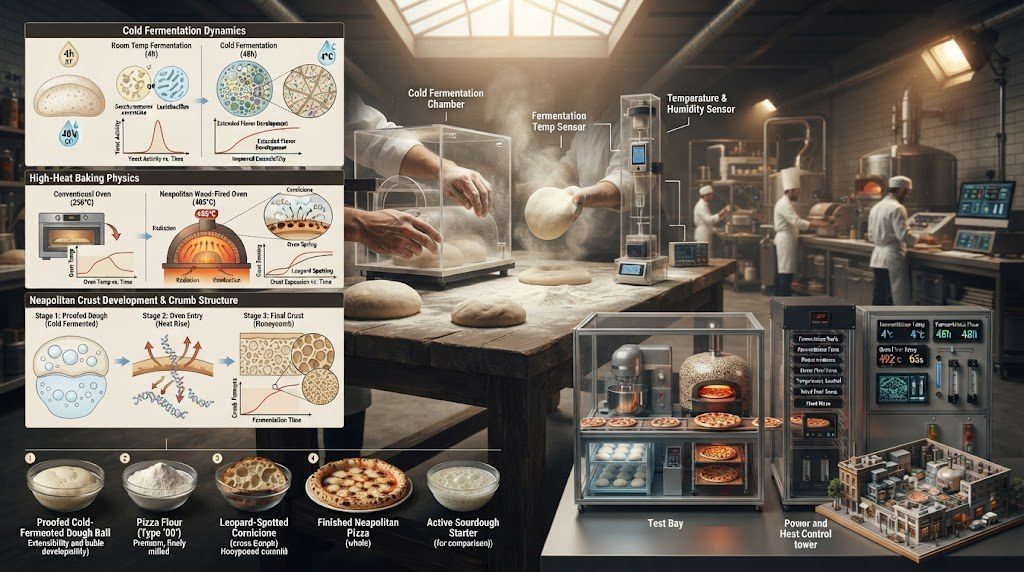
In global culinary culture, few dishes command as passionate a following or as rigorous an engineering standard as authentic artisan pizza. From the blistered, pillowy, leopard-spotted cornicione of a traditional Neapolitan pizza baked in 60 seconds at 485°C (900°F) to the crisp, airy, olive-oil-fried crust of a Roman pizza al taglio or Detroit square, true pizza excellence is governed by the physics of high-temperature heat transfer and enzymatic dough development. Pizza dough is not merely flatbread; it is an engineered, ultra-high-heat leavened structure designed to endure extreme thermal flux without drying out or burning.
This authoritative technical guide examines the materials science and thermodynamic execution of artisan pizza dough. It investigates Italian Tipo 00 flour specifications and W-index gluten strength, analyzes cold fermentation biochemistry and enzymatic sugar liberation over 72 hours, details the three modes of high-heat oven heat transfer (conduction, convection, and radiant emissivity), explores the chemical mechanics of “leopard spotting” (cornicione blisters), and provides exact formulations for home and commercial ovens.
1. Flour Metallurgy: The Italian Classification and The W-Index
In North America, flour is classified primarily by crude protein percentage (e.g., Cake Flour 8%, All-Purpose 10.5%, Bread Flour 12.7%). In Italy, flour is classified legally by ash content (mineral residue after incineration) and milling extraction, ranging from Tipo 00 (purest endosperm, ash < 0.55%) to Tipo 2 (whole wheat, ash > 0.85%).
1.1 The Meaning of Tipo 00 Flour
Tipo 00 Flour is milled from the central starchy endosperm of soft wheat (Triticum aestivum). It is pulverized to an ultra-fine, powder-like particle size. Because it is completely stripped of sharp, abrasive bran flakes and wheat germ, the glutenin and gliadin proteins can form a silky, uninterrupted, highly extensible gluten network that stretches paper-thin without tearing under the pizzaiolo’s hands.
1.2 The Alveograph W-Index and P/L Ratio
Professional pizza flour is graded using the Chopin Alveograph Test, which inflates a thin sheet of dough with air until it bursts, recording two fundamental rheological parameters:
- W-Index (Baking Strength / Energy): Measures the total mechanical work required to burst the dough bubble. Standard supermarket flours have low strength ((W = 180–220)). Authentic long-fermentation pizza flours (such as Caputo Pizzeria or Caputo Cuoco) feature high strength ((W = 280–320)), providing the structural backbone to withstand 48 to 72 hours of enzymatic fermentation without liquefying.
- P/L Ratio (Tenacity to Extensibility): Measures the ratio of peak dough resistance ((P)) to bubble elongation length ((L)). The ideal pizza dough requires a balanced ratio of (P/L = 0.50–0.60). High (P/L) (> 0.8) indicates stiff, rubbery dough that springs back when stretched; low (P/L) (< 0.4) indicates slack, fragile dough that tears easily.
2. Cold Fermentation Chemistry: 24 to 72-Hour Enzymatic Kinetics
The hallmark of artisan pizza dough is extended Cold Fermentation (Cold Retardation) at 3°C to 5°C (37°F to 41°F). Mixing dough and baking it within 2 hours produces an uninspired crust: tough, dense, pale, and difficult to digest. Slowing fermentation unlocks three critical biochemical transformations:
2.1 Protease-Mediated Gluten Relaxation
Endogenous protease enzymes within the wheat endosperm gently cleave strong peptide bonds in the dense glutenin polymers. Over 48 to 72 hours in the cold, this slow enzymatic tenderization relieves mechanical tension, transforming elastic, springy dough into an exceptionally supple, extensible dough that can be stretched effortlessly into a 12-inch disc in seconds without a rolling pin.
2.2 Amylase Sugar Liberation and Complex Flavor Synthesis
While commercial instant yeast operates at near-dormant speeds at 4°C, wheat alpha-amylase and beta-amylase enzymes continue breaking down complex, insoluble starch polymers into simple, fermentable maltose and glucose sugars. In an unretarded dough, yeast consumes all simple sugars immediately. In a 72-hour cold-retarded dough, sugar accumulation peaks: this abundant pool of reducing sugars provides the fuel for explosive Maillard browning and caramelization in the oven, while bacterial metabolic byproducts synthesize deep, complex organic esters reminiscent of fine sourdough.
2.3 Digestibility and FODMAP Breakdown
Prolonged fermentation breaks down complex oligosaccharides, fructans, and fermentable carbohydrates (FODMAPs) that frequently cause post-meal gastrointestinal bloating in sensitive individuals. The starch and protein molecules are essentially “pre-digested” enzymatically, yielding a light, airy pizza that leaves diners feeling energized rather than weighed down.
3. High-Heat Thermodynamics: The Neapolitan 900°F Physics
Authentic Neapolitan Pizza (regulated under UNESCO cultural heritage and the Associazione Verace Pizza Napoletana, AVPN) must bake in a wood-fired refractory stone oven at temperatures between 450°C and 485°C (850°F to 900°F) for exactly 60 to 90 seconds. Baking at this blistering temperature is governed by three simultaneous heat transfer mechanisms:
3.1 Conductive Heat Transfer (The Hearth Floor)
Direct contact between the raw dough bottom and the porous refractory clay hearth (traditionally Biscotto di Sorrento clay) drives heat conduction. Biscotto clay has a low thermal conductivity ((k \approx 0.6–0.8 \text{ W/m}\cdot\text{K})) compared to dense cordierite stone ((k \approx 2.5 \text{ W/m}\cdot\text{K})). This low conductivity is critical: it meters heat slowly into the crust bottom, allowing 60 to 90 seconds of baking without scorching the base to black carbon ash.
3.2 Convective Heat Transfer (The Rolling Fire Dome)
The dome of a Neapolitan oven is engineered as a low, parabolic vault. Flames generated from split hardwood roll across the curved refractory ceiling, sweeping super-heated gases (600°C+) over the top of the pizza. This convective hurricane vaporizes surface moisture on tomato sauce and fresh mozzarella instantly, bubbling the toppings without drying them out.
3.3 Radiant Heat Emissivity (Blackbody Radiation)
Under the Stefan-Boltzmann Law, radiant thermal energy emitted from the incandescent oven ceiling scales with the fourth power of absolute temperature ((E = \epsilon \sigma T^4)). At 485°C (758 Kelvin), radiant heat flux is astronomical—more than six times greater than inside a standard home kitchen oven at 250°C (523 Kelvin). This radiant energy browns the elevated rim of the crust within seconds.
4. The Science of Leopard Spotting (Cornicione Chemistry)
The definitive visual benchmark of artisan Neapolitan pizza is leopard spotting—a constellation of tiny, charred, dark-brown or black micro-blisters scattered across a pale, pillowy, highly expanded crust rim (the cornicione):
- Micro-Bubble Nucleation: During 48 to 72 hours of cold fermentation, tiny micro-bubbles of carbon dioxide migrate to the outermost surface skin of the dough balls.
- Steam Explosion in Micro-Pores: When thrust onto the 485°C stone hearth, liquid moisture trapped in these sub-millimeter surface bubbles undergoes an explosive phase change into steam, inflating the surface into paper-thin, raised micro-domes.
- Selective Charring: Because these raised micro-blister domes project upward into the super-heated radiant atmosphere and possess virtually zero thermal mass, their water flashes off in seconds. The localized carbohydrates and proteins immediately surge past 200°C to 250°C, undergoing rapid Maillard pyrolysis and caramelization, charring into crisp, smoky, bitter-sweet black spots while the valley of dough beneath remains pale, tender, and moist.
5. Home Oven Adaptation: The Baking Steel Revolution
Standard home kitchen ovens cannot reach 485°C; they are electronically limited to 260°C (500°F) or 290°C (550°F). Baking pizza on a standard aluminum tray or ceramic stone at 260°C requires 12 to 15 minutes, resulting in a dehydrated, pale, cardboard-like crust.
Thermal Conductivity of Steel vs. Ceramic Stone
To overcome home oven temperature limits, food scientist Nathan Myhrvold (author of Modernist Cuisine) championed the Baking Steel—a 1/4-inch to 1/2-inch thick solid plate of carbon steel positioned on the top rack of a home oven directly beneath the broiler element:
- Carbon steel possesses an enormous thermal conductivity ((k \approx 45–50 \text{ W/m}\cdot\text{K}))—roughly 18 times higher than ceramic pizza stone and 60 times higher than refractory brick.
- Due to this high heat transfer rate, preheated steel transfers thermal energy into the dough bottom at blistering speeds, mimicking the heat flux of an 800°F commercial oven.
- Coupled with the oven’s 500°C infrared overhead broiler element, a Baking Steel bakes a stunning, blistered, artisan pizza in just 4 to 5 minutes, achieving authentic leopard spotting in a standard apartment kitchen.
6. Master Artisan Pizza Dough Formulation (65% Hydration Neapolitan Style)
The following standardized formulation provides the exact ratios for a 72-hour cold-fermented artisan pizza dough:
| Ingredient | Baker’s % | Weight for 4 Dough Balls (260g each) | Technical Role & Impact |
|---|---|---|---|
| Italian Tipo 00 Flour (Caputo Pizzeria, W280) | 100.0% | 630 g | High gluten quality withstands 72h cold fermentation; fine milling allows paper-thin stretching. |
| Pure Cold Water (18°C / 65°F) | 65.0% | 410 g | Provides optimal steam expansion and open cornicione crumb without excessive stickiness. |
| Fine Sea Salt (Non-Iodized) | 2.8% | 17.6 g | Crucial in pizza dough; tightens gluten cross-linking and slows enzymatic degradation over 72h. |
| Instant Dry Yeast (IDY) | 0.20% | 1.25 g (approx. 1/3 tsp) | Ultra-low yeast dosage prevents explosive over-fermentation during extended cold proofing. |
| Extra Virgin Olive Oil (Home Oven Optional) | 2.0% | 12.6 g | Omit for 900°F wood ovens; add for home ovens to retain moisture and promote browning at 550°F. |
7. Frequently Asked Questions (FAQ) Regarding Artisan Pizza
Q1: Why should you never use a rolling pin to stretch artisan pizza dough?
Answer: Over days of fermentation, yeast produces millions of fragile carbon dioxide gas bubbles that migrate toward the outer rim (the cornicione). When you hand-stretch pizza dough (using the classical Neapolitan “slap” or steering-wheel technique), your fingertips gently press the center flat while physically pushing and herding these precious micro-gas pockets outward into the rim. Using a rolling pin acts like a mechanical steamroller: it brutally ruptures and crushes all internal gas alveoli, completely deflating the dough and producing a flat, dense, tough rim with zero oven spring.
Q2: Why does authentic Neapolitan pizza dough omit oil and sugar?
Answer: True Neapolitan pizza is baked in intense 485°C (900°F) wood-fired ovens. At 900°F, natural sugars liberated from flour are more than sufficient to achieve full caramelization and leopard spotting in 60 seconds. Adding extra sucrose or olive oil to the dough would be disastrous: the supplemental sugar and fat would burn into bitter, acrid black soot before the raw interior dough had time to cook through. However, for home ovens operating at 260°C (500°F), adding 2% olive oil and 1% malt or sugar is recommended because it compensates for low oven heat, retaining moisture and assisting browning over a 5-minute bake.
Q3: What causes pizza dough to fight back and snap back when you try to stretch it?
Answer: Dough snap-back (high elastic recoil) is caused by cold, unrelaxed gluten. If dough balls are taken straight out of a 4°C refrigerator and stretched immediately, the glutenin polymers are tightly contracted and rigid. Attempting to stretch cold dough tears the protein web and snaps back like a rubber band. Dough balls must be brought to room temperature (20°C / 68°F) for at least 1.5 to 2 hours prior to stretching, allowing thermal energy to soften gluten elasticity and unlock fluid extensibility.
Q4: Why is low-moisture whole milk mozzarella preferred over fresh buffalo mozzarella for NY and home ovens?
Answer: Fresh buffalo mozzarella (Mozzarella di Bufala) contains over 60% water. In a 900°F wood-fired oven, this moisture flashes off into steam in 60 seconds. In a home oven baking for 5 to 8 minutes at 260°C, that massive water content releases as liquid whey onto the pizza, turning the cheese and tomato sauce into a soupy puddle that saturates the crust into soggy mush. Low-moisture whole milk mozzarella (moisture approx. 45%–50%) melts into a velvety, stringy, golden blanket with superior stretch and zero pooling water.
Q5: What is Semolina (Semola Rimacinata) and why is it used for bench dusting?
Answer: When launching a stretched, topped pizza from a peel into a blazing oven, standard flour tends to absorb moisture from the dough, turning into a sticky paste that welds the pizza to the peel, resulting in a disastrous oven spill. Furthermore, raw white flour burns instantly into bitter black soot on the stone hearth. Semola Rimacinata (fine-milled durum wheat semolina) consists of coarse, hard, micro-spherical granules. These tiny grains act like mechanical ball bearings under the dough, allowing the pizza to glide effortlessly off the peel into the oven without sticking or smoking.
8. Culinary Summary and The Pursuit of Crust Perfection
Artisan pizza is a masterclass in culinary physics. The interplay between high-W-index Tipo 00 flour, prolonged cold fermentation that enzymatically tenderizes gluten, and explosive high-heat thermodynamics dictates the boundary between mediocre fast-food pizza and transcendent gastronomic art.
Whether firing a traditional wood-fired brick oven at 485°C in Naples or harnessing the radiant power of a Baking Steel beneath a home broiler, mastering these scientific principles guarantees an ethereal pizza crust: crackling crisp on the outside, light and honeycombed within, and bursting with complex fermented flavor.