In classical French haute cuisine, few culinary presentations rival the theatrical elegance of Cooking En Papillote (literally, “in parchment” or paper envelope). When a puffy, golden-brown parchment pouch is carried to the dining table and sliced open with a sharp knife before an expectant guest, an intoxicating plume of fragrant vapor rushes outward, filling the dining room with the concentrated botanical essences of fresh herbs, dry white wine, shallots, and tender seafood.
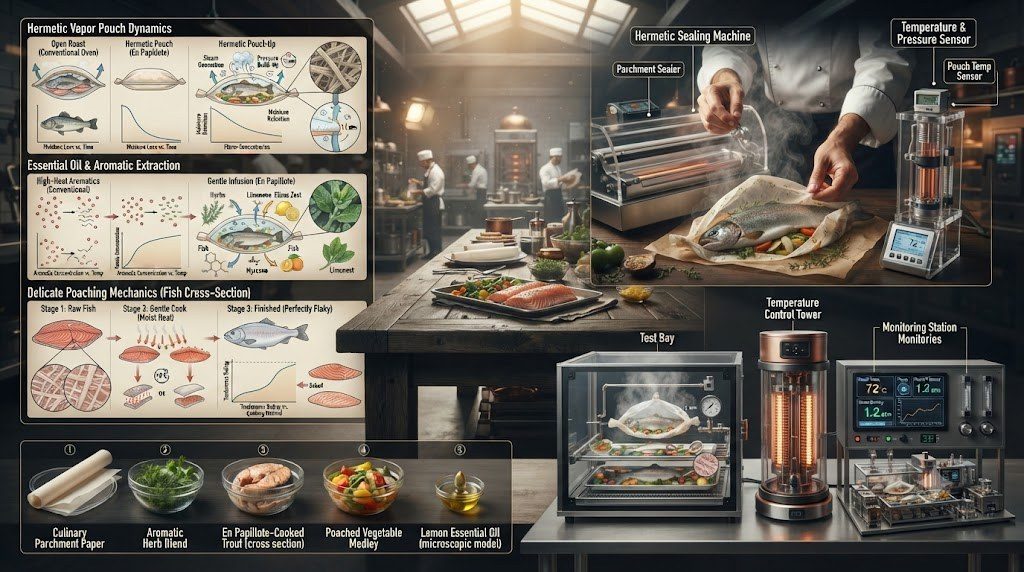
Yet behind this refined tableside ceremony lies an ingenious culinary mechanism: converting folded parchment paper or aluminum foil into a self-contained, hermetically sealed micro-steamer and aroma extraction chamber. This comprehensive technical study investigates the physical thermodynamics, organic vapor dynamics, and protein kinetics of cooking en papillote. It analyzes the mechanical physics of pleated perimeter crimping, the gentle phase-change thermodynamics of internal steam poaching, and the volatile organic chemistry of botanical terpene extraction.
1. The Engineering Physics of the Hermetic Vapor Pouch
Cooking en papillote creates a miniature, self-pressurized cooking micro-climate that operates entirely independently of the surrounding dry oven air:
1.1 The Enclosure Mechanics and Vapor Sealing
A classic papillote is fabricated by cutting a sheet of unbleached parchment paper (sulfite-treated cellulose) into an asymmetrical heart shape. Food—typically a delicate fish fillet, sliced vegetables, and aromatics—is placed on one half of the heart:
- The opposing paper half is folded over to enclose the ingredients.
- Starting at the rounded top edge, the cook makes small, overlapping triangular pleats (folds), crimping each pleat tightly over the previous one until reaching the pointed tail.
- The tail is twisted tightly beneath the pouch. This mechanical crimping creates a flexible, semi-gas-tight hermetic perimeter seal without requiring glue or fasteners.
1.2 Internal Thermal Expansion and Ballooning Physics
When the sealed pouch is placed onto a heavy preheated baking sheet inside a 200°C (400°F) oven, heat transfers conductively through the base of the paper and convectively through the top surface:
- Liquid moisture inside the pouch—contributed by the fish, sliced vegetables, and a splash of wine (approx. 1 to 2 tablespoons)—reaches 100°C and flashes into water vapor.
- According to the Ideal Gas Law ((P V = n R T)), as liquid water converts to steam, its volume expands exponentially.
- This expanding vapor exerts positive internal pressure against the parchment walls, causing the paper envelope to inflate like a small hot-air balloon.
- This ballooning creates a protective convective vapor canopy: the fish is completely suspended within an envelope of 100°C saturated steam, shielded from dry, scorching radiant heat.
2. Organic Vapor Chemistry: Botanical Terpene Extraction
Cooking en papillote is fundamentally a method of In-Situ Steam Distillation of Volatile Essential Oils.
2.1 The Problem of Open Cooking Aroma Loss
In standard open pan-frying or baking, when delicate fresh herbs (tarragon, chervil, dill, thyme) and aromatics (shallots, citrus zest) are heated, their volatile aroma molecules—such as limonene, estragole, linalool, and citral—evaporate immediately into the kitchen atmosphere. By the time the food reaches the dining table, up to 90% of these delicate top-notes have vanished into the exhaust hood.
2.2 Closed-Loop Condensation and Lipid Absorption
Inside an airtight papillote pouch, these volatile aromatic compounds have nowhere to escape:
- As steam vaporizes, it strips essential oils and terpene molecules from fresh herbs, citrus zest, and shallots.
- When this terpene-laden steam hits the cooler top parchment ceiling, it condenses back into liquid aromatic droplets.
- These droplets drip continuously back onto the fish below, where lipid-soluble aroma molecules dissolve directly into the omega-3 oils and cellular membranes of the seafood.
- The entire protein is steeped in a closed-loop cycle of perpetual aromatic reflux, infusing flavor depths impossible to achieve in an open pan.
3. Seafood Protein Science: Elimination of Moisture Loss
Delicate white fish fillets—such as Dover sole, Atlantic cod, sea bass, red snapper, and halibut—possess fragile muscle structures with very low collagen content (approx. 3% vs. 15% in beef) and minimal intramuscular fat.
3.1 The Danger of Overcooking Delicate Fish
In fish muscle tissue, myosin denatures at 40°C to 50°C (104°F to 122°F), while collagen melts at just 45°C. If delicate fish is subjected to dry radiant oven heat, the outer layers easily surpass 65°C, causing violent muscle shrinkage and squeezing out all intracellular moisture, leaving the fish dry and stringy.
3.2 The Self-Regulating Vapor Cushion
Because the interior of a papillote pouch is 100% saturated with steam, the ambient cooking temperature cannot exceed 100°C. Furthermore, as long as internal liquid is present, evaporative cooling buffers the internal environment. The seafood poaches gently in its own concentrated juices and aromatics, ensuring that internal fish temperatures coast smoothly into the perfect 50°C to 54°C (122°F to 130°F) window, yielding succulent, silky, translucent flakes that melt on the tongue.
4. Quantitative Papillote Recipe Engineering Matrix
The following technical data table outlines the optimal ingredient ratios, liquids, and baking parameters for world-class papillote preparations:
| Main Protein / Component | Aromatic Botanical Bed | Liquid Medium (Per Pouch) | Oven Temp & Bake Time | Sensory Flavor Profile |
|---|---|---|---|---|
| Wild Black Sea Bass / Halibut (180g) | Julienned leeks, fennel, lemon wheel, fresh tarragon sprig | 15 ml Dry Vermouth + 10g cold butter | 200°C (400°F) for 10 – 12 min | Anise, licorice top-notes with silky, buttery, translucent fish flakes. |
| Atlantic Salmon Fillet (Skinless) | Zucchini ribbons, cherry tomatoes, fresh dill, minced shallots | 15 ml Dry White Wine + 5 ml EVOO | 200°C (400°F) for 12 – 14 min | Bright tomato acid cuts through rich salmon lipids; fresh grassy dill finish. |
| Jumbo Sea Scallops & Gulf Prawns | Shiitake mushrooms, scallions, fresh ginger slivers, cilantro | 10 ml Shaoxing Rice Wine + 3 ml Sesame Oil | 205°C (400°F) for 8 – 10 min | Umami-rich, warming ginger aromatics; tender, sweet shellfish. |
| Boneless Skinless Chicken Breast | Thinly sliced bell peppers, red onion, garlic, oregano, thyme | 20 ml Chicken Broth + 10g Butter | 190°C (375°F) for 18 – 20 min | Remarkably juicy chicken without the chalkiness of standard roasted breast. |
5. Cellulose Permeability and Sulfite Treatment in Culinary Parchment
Culinary parchment paper is not ordinary wood paper; it is manufactured by passing pure cellulose paper sheets through a bath of concentrated sulfuric acid. This acid treatment partially dissolves the outer cellulose fibers, which immediately reprecipitate into a dense, translucent, high-strength gelatinous membrane known as vegetable parchment.
This chemical structure gives culinary parchment three exceptional physical characteristics: (1) Remarkable wet tensile strength that prevents tearing when saturated with steam; (2) Exceptional grease resistance; and (3) Semi-permeable breathability that allows micro-amounts of excess moisture vapor to transpire outward while trapping 98% of volatile aroma molecules within the pouch. Siliconized parchment takes this further by adding a micro-thin coating of polydimethylsiloxane, ensuring total release of delicate fish skin without sticking.
6. Baking Surface Thermal Flux: Baking Stones vs. Heavy Steel Sheets
The speed and visual volume of a papillote’s inflation depends heavily on the thermal conductivity of the underlying baking vessel. If placed on a thin, lightweight aluminum sheet pan, conductive heat transfer to the base of the pouch is sluggish, delaying steam generation by several minutes.
Modern culinary technique recommends placing papillote pouches directly onto a preheated heavy baking stone or 6 mm baking steel sitting on the bottom oven rack. The intense stored thermal reservoir of the steel conducts instantaneous heat into the base of the paper, flashing internal liquids into steam within 90 seconds. This drives immediate, explosive ballooning, creating a towering, taut paper dome that shields delicate seafood from radiant scorching throughout the bake.
7. Envelope Material Selection: Parchment Paper vs. Aluminum Foil
Chefs frequently debate whether traditional parchment paper or heavy-duty aluminum foil makes the superior pouch:
- Unbleached Parchment Paper: The traditional French choice. Parchment paper is semi-permeable and aesthetically magnificent; it puffs up and turns a beautiful toasted golden-brown in the oven, creating an irresistible tableside visual showpiece. However, parchment requires precise folding technique to create a reliable crimp.
- Heavy-Duty Aluminum Foil: Impermeable, robust, and effortlessly crimped. Aluminum foil creates a completely 100% hermetic air seal with zero vapor weeping. It is ideal for high-heat camping coals or barbecue grills where paper would scorch and ignite. However, foil lacks the organic visual charm and breathability of parchment.
8. Frequently Asked Questions (FAQ) Regarding Cooking En Papillote
Q1: Why does a papillote pouch fail to inflate in the oven?
Answer: Failure to inflate is caused by two errors: A loose perimeter crimp or insufficient internal liquid. If the overlapping pleats are not folded and creased firmly with your fingernail, escaping steam bleeds out through gaps faster than it is generated. Additionally, if the pouch contains only dry ingredients with zero added liquid (or zero water-rich vegetables like sliced zucchini or tomatoes), there is inadequate water to generate expanding steam volume. Always add 1 to 2 tablespoons of wine, citrus juice, or stock.
Q2: Can hard, dense root vegetables (like carrots and potatoes) be cooked en papillote?
Answer: Not raw. Delicate fish fillets cook in just 10 to 12 minutes, whereas raw diced carrots or potatoes require 30 to 45 minutes to soften. If placed together raw, the fish will be hopelessly overcooked by the time the carrots are edible. Hard vegetables must either be sliced paper-thin on a mandoline (e.g., razor-thin fennel or zucchini ribbons) or pre-blanched in boiling water for 3 to 4 minutes before being assembled into the pouch.
Q3: How do you determine if the fish is fully cooked without cutting the pouch open?
Answer: Puncturing the pouch with a thermometer defeats the entire tableside aroma presentation. Professional cooks rely on visual and tactile cues: When the parchment has fully ballooned into a taut dome and turned a rich toasted golden-brown (typically at the 10-to-12-minute mark at 200°C), the steam pressure has reached equilibrium and the fish is cooked. Alternatively, insert a thin metal cake tester probe through the crimped fold into the center of the fish for 5 seconds; if the metal tip feels hot against your lower lip, the interior is done.
Q4: Should raw butter or oil be added inside the pouch?
Answer: Yes, a small pat of cold unsalted butter (10 grams) or a drizzle of extra virgin olive oil is vital. Lipids act as a solvent that captures and dissolves fat-soluble volatile terpenes from herbs and citrus zest. Furthermore, as the fish releases natural juices during cooking, the melted butter and wine naturally emulsify together into a light, savory pan-jus directly inside the paper envelope.
Q5: Can papillote pouches be assembled in advance and refrigerated before cooking?
Answer: Yes, but with one critical constraint: Do not add acidic liquids (lemon juice or wine) or salt until right before baking. If assembled hours in advance, salt and acid will “ceviche-cure” the raw fish in the cold refrigerator, chemically denaturing proteins and breaking down the parchment paper into a soggy, tear-prone mush. Assemble the dry ingredients, seal the pouch partially, and inject the wine and seal the final pleat just before sliding the sheet pan into the oven.
Q6: What is the proper tableside etiquette for serving a dish en papillote?
Answer: Serve the hot, puffed parchment pouch directly on a warm dinner plate. Hand the dining guest a pair of culinary scissors or a sharp steak knife. Instruct the guest to cut an “X” across the top dome and pull back the flaps, allowing them to experience the concentrated aroma cloud first-hand before enjoying the perfectly poached fish directly from the paper envelope.
Q7: Can aromatics inside a papillote pouch be infused with citrus slices without developing bitter rind flavors?
Answer: While thin citrus slices (lemon, lime, orange) provide vibrant acidity and visual elegance, whole raw citrus slices contain the white spongy inner rind (the albedo), which is packed with limonin and naringin—intensely bitter terpene glycosides. In the closed 100°C steam canopy of a papillote, these bitter compounds dissolve into the cooking juices. To achieve bright citrus brightness without bitterness, chefs recommend either: (1) Segmenting the citrus fruit into pure flesh supremes without skin or albedo; or (2) Grating the micro-thin colored outer zest (the flavedo) with a microplane directly over the fish.
9. Culinary Summary and The Elegance of Sealed Vapor
Cooking en papillote is the ultimate union of thermodynamic efficiency and culinary theater. By converting simple parchment into an airtight, self-pressurized steaming chamber, cooks poach delicate seafood with gentle precision, trap fleeting aromatic terpenes, and deliver an unforgettable multisensory dining experience that captures the pure essence of classical cuisine.