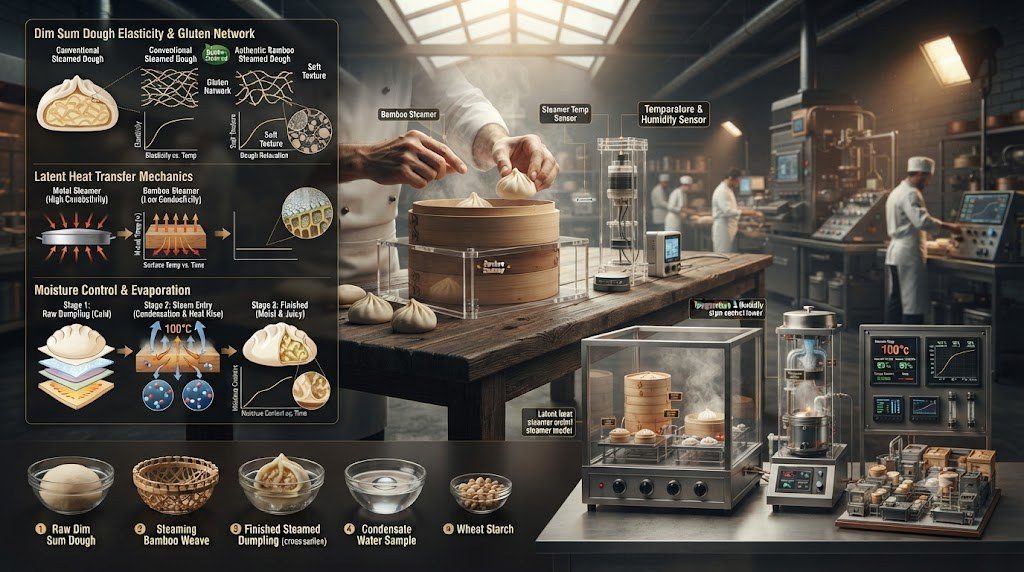
For more than two millennia, the multi-tiered Woven Bamboo Steaming Basket (Zhēnglóng, 蒸笼) has stood as one of the most sophisticated, sustainable, and thermodynamically flawless cooking apparatuses in culinary history. Central to Cantonese dim sum culture—producing translucent crystal har gow shrimp dumplings, pillowy char siu bao buns, and delicate soup dumplings (xiao long bao)—the bamboo steamer achieves a delicate balance between moisture delivery and steam evacuation that modern metallic steamers struggle to replicate.
While stainless steel steamers suffer from condensation drip that ruins delicate doughs, bamboo acts as an active organic thermodynamic regulator. This comprehensive technical study examines the physical thermodynamics and starch biochemistry of bamboo steaming. It explores the colossal energy transfer of latent heat of vaporization, details the hygroscopic moisture-buffering capacity of vascular bamboo fibers, analyzes starch retrogradation and gelatinization kinetics in dim sum doughs, and provides an authoritative engineering guide to multi-tiered heat profiling.
1. The Thermodynamics of Steam: The Colossal Power of Latent Heat
In culinary arts, water is often considered a gentle cooking medium. Yet from a physical standpoint, steam is the most violent, high-energy heat transfer medium in the kitchen. The immense efficiency of steaming is governed by the thermodynamic transition between liquid water and vapor:
1.1 Sensible Heat vs. Latent Heat of Vaporization
When liquid water is heated from 20°C to 100°C, it absorbs Sensible Heat: (\Delta Q = m \cdot c_p \cdot \Delta T), where (c_p \approx 4.184 \text{ J/g}\cdot\text{K}). Heating one gram of water by 80°C requires approximately 335 Joules of energy.
However, to convert that same 1 gram of boiling 100°C water into 100°C steam, the water must absorb the Latent Heat of Vaporization ((\Delta H_{\text{vap}})): a staggering 2,260 Joules per gram. This means steam contains nearly seven times more thermal energy than boiling water at the exact same temperature.
1.2 Phase-Change Condensation Heat Transfer
When 100°C steam enters the bamboo basket and contacts the cool surface of a raw dumpling (at 20°C):
- The steam immediately condenses back into liquid water upon the dumpling skin.
- During this phase change, the steam instantly dumps its stored 2,260 Joules per gram of latent heat directly into the food surface.
- This results in an exceptionally high heat transfer coefficient: (h_{\text{steam}} \approx 1,000 – 5,000 \text{ W/m}^2\cdot\text{K}), dwarfing dry air convection ((20–50 \text{ W/m}^2\cdot\text{K})) by two orders of magnitude. Food cooks with extreme rapidity while remaining in a 100% relative humidity environment.
2. Organic Material Science: Why Bamboo Outperforms Stainless Steel
Anyone who has attempted to steam delicate dumplings or yeast buns inside a standard stainless steel or glass pot has encountered the catastrophic Condensation Drip Defect:
2.1 The Metal Condensation Flaw
Metal and glass are impermeable, non-hygroscopic materials with relatively high thermal conductivity. When steam hits a cold stainless steel lid, it rapidly cools and condenses into large water droplets. Gravity pulls these heavy droplets together until they rain down onto the delicate food below. In dim sum, a single drop of condensed boiling water landing on a raw dumpling instantly blisters the skin, turns the dough into gummy mush, and collapses leavened buns into soggy, wrinkled ruins.
2.2 Bamboo as a Hygroscopic Moisture Buffer
Bamboo is a natural bio-composite composed of cellulose microfibrils embedded in a lignin and hemicellulose matrix. Its unique anatomical structure features open longitudinal vascular bundles (xylem and phloem tubes) that provide extraordinary culinary advantages:
- Moisture Absorption (Hygroscopicity): The woven bamboo lid absorbs rising steam condensation directly into its cellular wood matrix. The lid never forms pooling water droplets; it simply swells slightly, buffering excess moisture.
- Micro-Permeability (Controlled Venting): The intricate woven pattern of the bamboo lid acts as a natural pressure relief valve. Unlike sealed pressure pots, bamboo allows excess spent steam to weep gently outward through millions of microscopic inter-fiber gaps, maintaining stable atmospheric pressure without stagnant, wet vapor accumulation.
- Thermal Insulation: Bamboo possesses an exceptionally low thermal conductivity ((k \approx 0.15–0.18 \text{ W/m}\cdot\text{K})). The woven lid insulates the cooking chamber against ambient kitchen drafts, preserving an exact, stable 98°C to 100°C internal steam environment.
3. Dim Sum Starch Science: Gelatinization and Crystal Skin Mechanics
The iconic dishes of the Cantonese dim sum tradition rely entirely on the precise starch chemistry enabled by bamboo steaming:
3.1 The Translucent “Crystal” Skin of Har Gow (Shrimp Dumplings)
The skin of authentic Har Gow is famous for being translucent, glossy, and elastic, allowing the pink shrimp filling to shine through. This skin contains zero wheat flour; it is formulated from a blend of Wheat Starch (with all gluten removed) and Tapioca or Corn Starch:
- The starch is scalded with boiling water, triggering immediate partial starch gelatinization and pre-hydration.
- When placed in the bamboo steamer, the continuous 100°C condensing steam completes the gelatinization of the amylose and amylopectin granules.
- Because there is no gluten network to form an opaque, white protein matrix, the fully gelatinized starch cools into an amorphous, highly translucent, chewy gel structure with exceptional tensile strength.
3.2 Leavened Steamed Buns: Char Siu Bao and Mantou
Unlike baked Western bread, which develops a rigid, browned, caramelized crust via dry heat and Maillard browning, steamed Chinese yeast buns (Baozi) are snow-white, gossamer-soft, and tender:
- In the 100% humidity of the bamboo basket, surface starch gelatinizes into a micro-thin, glossy, skin-like barrier that seals in carbon dioxide gas.
- Because the temperature never exceeds 100°C, sugar caramelization and Maillard browning are completely prevented, preserving the pristine white aesthetic.
- The gentle, ambient steam prevents the surface from drying or hardening, allowing the yeast dough to expand to maximum volume with an ethereal, cloud-like crumb.
4. Fluid Mechanics of the Multi-Tiered Stacking System
One of the brilliant engineering aspects of the bamboo steamer is its modular, stackable architecture. In professional dim sum houses, stacks of up to ten bamboo baskets are positioned over a single boiling wok or industrial steam boiler.
4.1 The Vertical Thermal Gradient
Because hot steam naturally rises due to buoyancy (lower density than cool air), a dynamic thermal and pressure equilibrium establishes across the vertical stack:
| Basket Position in Stack | Effective Steam Quality | Relative Cooking Rate | Optimal Culinary Application |
|---|---|---|---|
| Bottom Tier (Closest to Wok Water) | Super-saturated, high turbulence, hottest | Fastest (100% flux) | Dense meats, spare ribs in black bean sauce, whole fish fillets. |
| Middle Tiers (2 to 4) | Uniform dry-saturated steam, steady flow | Steady & Balanced | Dumplings (Har Gow, Shumai), Xiao Long Bao soup dumplings. |
| Top Tier (Under Woven Lid) | Gentle, slightly expanded vapor cushion | Gentlest (85%–90% flux) | Fluffy yeast buns (Char Siu Bao, Mantou), delicate custard tarts. |
5. Lignin and Cellulose Fiber Mechanics: Moisture Absorption Isotherms
The botanical tissue of the timber bamboo species (Phyllostachys edulis or Moso bamboo) utilized in culinary steamers possesses an extraordinary equilibrium moisture content (EMC). Unlike homogeneous hardwoods, bamboo displays a distinct radial density gradient, with dense vascular bundles packed tightly along the outer culm cortex and looser parenchyma cells toward the interior lumen.
During the steaming cycle, this cellular architecture exhibits high moisture adsorption capacity along the inner face while allowing vapor transmission outward along the fibrous tracheids. This natural hygroscopic behavior prevents moisture from reaching the critical droplet-forming surface tension threshold, effectively eliminating condensation droplets while maintaining a saturated microclimate of 100% relative humidity.
6. Dim Sum Emulsion Fillings: Fat Melting Points and Gelatin Cubes
The thermodynamic genius of the bamboo basket is demonstrated in the preparation of classic Shanghai soup dumplings (Xiao Long Bao). The filling is created by blending seasoned ground pork with cubes of solid, chilled aspic (concentrated collagen-rich pork skin broth):
- At ambient temperatures (20°C), the collagen aspic remains a firm, workable elastic gel that can easily be folded inside delicate wheat dough wrappers.
- Inside the 100°C bamboo steam chamber, condensing steam transfers latent heat through the wrapper in less than 90 seconds.
- As internal temperatures pass 40°C to 50°C, the collagen triple-helices melt completely into a piping-hot, rich, savory liquid broth, encapsulated within the tender wrapper without rupturing the delicate steamed dough.
7. Basket Maintenance, Hygiene, and Liners
To ensure longevity, flavor purity, and sanitary performance, bamboo baskets require specialized care:
- Culinary Basket Liners: Food must never be placed directly onto the raw bamboo slats, where wet starch sticks and tears upon removal. Always line the base with perforated parchment paper circles, reusable food-grade perforated silicone mats, or traditional organic leaves (such as fresh napa cabbage leaves, banana leaves, or lotus leaves). Lotus leaves infuse food with subtle herbaceous tannins.
- Sanitization Protocol: Never wash bamboo steamers with chemical dish detergents or soak them in stagnant soapy sinks. Soapy surfactants penetrate deeply into porous bamboo fibers and will evaporate into future food. Clean bamboo baskets by scrubbing them immediately after use with hot water and a stiff nylon or traditional bamboo broom brush (whisk), then steam empty for 5 minutes to sanitize.
- Air-Drying Storage: Bamboo must dry thoroughly in an open, well-ventilated rack. Storing damp bamboo baskets in closed, dark cabinets promotes fungal mold growth and mildew.
8. Frequently Asked Questions (FAQ) Regarding Bamboo Steaming
Q1: How do you prevent a wok or pot from boiling dry beneath the bamboo steamer?
Answer: Boiling dry is a catastrophic error that ruins the wok and scorches the bamboo steamer. Always maintain at least 5 to 7 cm (2 to 3 inches) of boiling water in the wok, ensuring the water level sits approximately 1 inch below the bottom slats of the basket (the basket must sit above the water, never submerged). To monitor water levels without lifting the heavy tiers, place a clean coin in the bottom of the wok; as long as the water is boiling, the coin will chatter and rattle against the metal. If the rattling stops, the water is dangerously low—immediately pour boiling kettle water down the side of the wok.
Q2: Why do Xiao Long Bao (Soup Dumplings) sometimes burst in the steamer?
Answer: Dumpling ruptures occur due to excessive internal steam pressure or sticking to the liner. If steamed over violent, raging heat, the gelatinized broth inside boils violently, expanding faster than the delicate wheat skin can stretch. Xiao Long Bao should be steamed over moderate, steady rolling steam for exactly 6 to 8 minutes. Additionally, ensure dumplings are spaced at least 2 cm apart; if dumplings touch during steaming, their skins fuse together and tear upon separation.
Q3: What causes steamed yeast buns (Baozi) to collapse and wrinkle when the lid is removed?
Answer: Wrinkled collapse is caused by thermal shock and rapid barometric contraction. While inside the hot 100°C steamer, gas bubbles inside the leavened dough are fully expanded. If the lid is ripped off abruptly, cold kitchen air rushes in, causing the trapped gas to contract instantly before the starch structure has fully set. To prevent collapse, turn off the heat and let the steamer rest undisturbed with the lid on for 3 to 5 minutes before gently cracking the lid open.
Q4: How does bamboo steaming preserve micronutrients compared to boiling?
Answer: Steaming is nutritionally superior because food is suspended entirely above the liquid water. Water-soluble vitamins—specifically Vitamin C, Thiamine (B1), and Folate (B9)—are easily leached out into cooking water during boiling. Steaming retains over 85% to 90% of water-soluble vitamins and natural antioxidant glucosinolates in brassica vegetables like bok choy and broccoli.
Q5: Can you use a bamboo steamer on a flat-bottomed electric induction cooktop?
Answer: Yes, provided you use an adapter. While bamboo steamers traditionally rest naturally in the sloping bowl of a round-bottomed carbon steel wok, they can be used with flat induction pots by resting the steamer atop a standard stockpot of matching diameter, or by using a stainless steel steamer adapter ring that creates a snug, leak-free seal over any saucepan.
Q6: Why must bamboo steamers be seasoned before their very first use?
Answer: Brand-new bamboo steamers contain residual wood sap, organic dust, and intense raw bamboo tannins that can impart an overpowering, bitter grassy odor to delicate foods. Before cooking food, season a new steamer by scrubbing it with hot water and steaming the empty baskets with their lid over boiling water (optionally with a few slices of fresh ginger or lemon) for 30 minutes. This sterilizes the wood, purges bitter tannins, and pre-hydrates the bamboo fibers.
Q7: What is the scientific advantage of using perforated silicone steaming mats over parchment paper?
Answer: Food-grade perforated silicone mats offer superior thermodynamic performance because their thermal stability and hydrophobic surface prevent starch adhesion completely, even with ultra-delicate gluten-free doughs like Har Gow crystal skins. Furthermore, engineered silicone mats feature precision micro-perforations calibrated to maintain uniform steam velocity across the entire base of the basket without blocking the natural vascular venting pathways of the bamboo floor.
9. Culinary Summary and The Mastery of Gentle Heat
The woven bamboo steamer is a testament to the brilliance of traditional food engineering. By exploiting the massive latent heat of vaporization while completely eliminating condensation drip through natural hygroscopic wood absorption, bamboo steaming provides an unrivaled culinary medium that honors the delicate textures of doughs, seafood, and dim sum artistry.