In the pantheon of global fried foods, traditional Japanese Tempura represents the absolute zenith of delicacy, lightness, and textural minimalism. Unlike heavy, thick Western beer-battered fish or dense Southern cornmeal crusts that encase food in an opaque structural armor, authentic Edomae tempura is characterized by an ethereal, semi-translucent, lace-like coating (the famous koromo). The fried shell is so light and crystalline that the vibrant pink stripes of a fresh kuruma prawn or the deep purple skin of an eggplant remain vividly visible through the shatteringly crisp, pale-golden lattice.
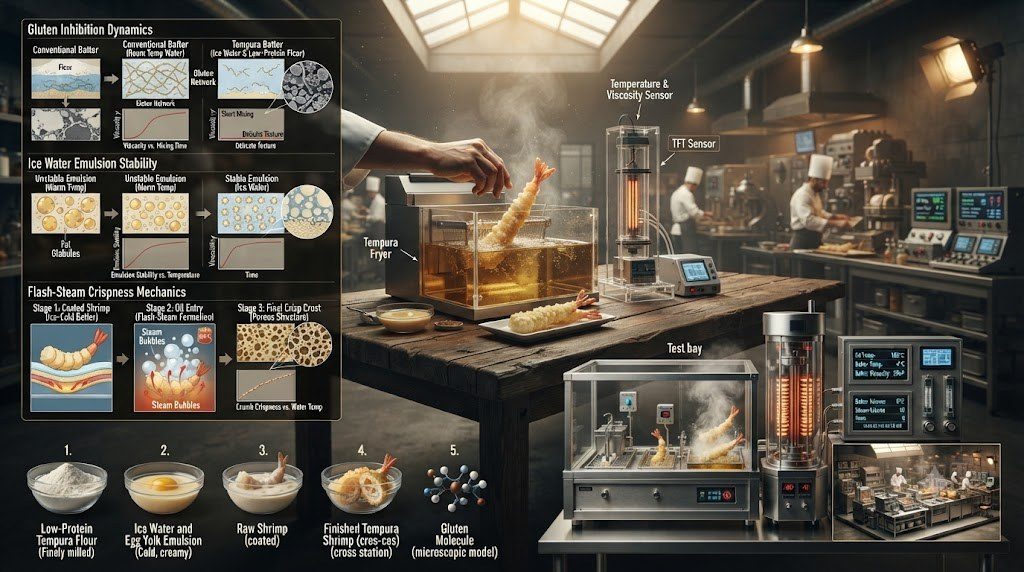
Achieving this fragile, non-greasy, glass-like coating is not an accident of culinary luck; it is a masterclass in the strict biochemical suppression of gluten formation, ice-water thermal shock kinetics, and flash-steam dehydration. This comprehensive technical guide explores the molecular physics and culinary execution of master-grade tempura. It examines protein inhibition via low-gluten flours, analyzes the fluid mechanics of lumpy cold batters, investigates the explosive boiling mechanics of sesame and tea-seed oil blends, and provides exact formulas and troubleshooting rules for world-class tempura.
1. The Gluten Problem: Why Standard Batters Fail in Tempura
The primary enemy of light, crispy tempura is gluten development. In bread and pizza, bakers work tirelessly to maximize gluten cross-linking. In tempura, the goal is near-total gluten suppression.
The Molecular Mechanics of Rubbery Batter
When wheat flour is mixed with water, mechanical shear forces align monomeric gliadin and polymeric glutenin proteins, allowing them to form covalent disulfide bonds ((\text{-S-S-})) and hydrogen-bonded networks:
- If gluten develops in a frying batter, the batter becomes elastic, viscous, and stretchy.
- When dropped into hot oil, an elastic gluten-rich batter traps steam in rubbery, sealed balloons that cannot escape. The batter absorbs massive quantities of oil, producing a thick, bready, chewy, greasy shell resembling a pancake.
- Authentic tempura demands an open, fragile, cellular network that shatters like crystal at the first bite. Every step in tempura preparation is chemically engineered to paralyze gluten formation.
2. The Three Pillars of Gluten Inhibition in Tempura
Master tempura chefs (the shokunin) achieve total gluten suppression through three rigorously controlled physical parameters:
2.1 Pillar 1: Ultra-Low-Protein, Unbleached Weak Flour (Hakurikiko)
Standard American all-purpose flour contains 10.5% to 11.5% protein; bread flour contains 12.7% to 14%. Authentic tempura requires Japanese Hakurikiko (Soft Wheat Flour), containing strictly 7.5% to 8.5% protein. By minimizing the raw concentration of glutenin and gliadin precursors, the maximum possible gluten yield is cut by over 40% from the start. Furthermore, many modern master chefs blend 20% to 30% pure cornstarch or potato starch (katakuriko) into the flour. Pure starch contains zero protein, diluting the gluten concentration further and ensuring a crystalline, brittle crunch.
2.2 Pillar 2: Near-Freezing Ice Water (0°C to 4°C / 32°F to 39°F)
The chemical reaction between glutenin, gliadin, and water is temperature-dependent. At room temperature (22°C / 72°F), enzymatic hydration and peptide cross-linking occur rapidly within seconds. At near-freezing temperatures (0°C to 4°C):
- Thermal kinetic energy is suppressed; molecular Brownian motion slows to a crawl.
- Water molecules cannot efficiently penetrate and hydrate the hydrophobic pockets of gluten proteins.
- By mixing the batter with ice-cold water containing floating ice cubes, gluten formation is biochemically paralyzed.
2.3 Pillar 3: Deliberately Incomplete Mixing (The Lumpy Batter Imperative)
In standard Western cooking, batters are whisked until perfectly smooth. In tempura, whisking the batter smooth is fatal. The batter must be mixed for only 10 to 15 seconds using long wooden chopsticks in a gentle stabbing and figure-eight motion:
- The flour should never be fully dissolved; the surface of the batter must remain covered in dry pockets, floating flour clumps, and lumps the size of peas.
- Every rotation of a mechanical whisk shears protein chains and builds gluten. Chopsticks merely submerge the flour clumps.
- Unmixed dry starch pockets act as structural discontinuities that disrupt the batter film, creating the iconic lace-like, airy texture rather than a solid sheet.
3. High-Heat Thermal Shock: The Explosive Steam Expansion Physics
When an ice-cold (2°C) battered ingredient is plunged into a reservoir of 180°C (350°F) hot oil, the resulting temperature delta ((\Delta T \approx 178^\circ\text{C})) triggers explosive physical transformations:
The Flash-Steam Vaporization Shock
- Explosive Phase Change: The liquid water in the cold batter encounters a massive thermal shock. Water flashes into high-pressure steam within 0.5 seconds, undergoing an instantaneous 1,600-fold volumetric expansion.
- Lace-Like Blossom (Hana Age): Because the batter has zero gluten elasticity, the expanding steam does not blow rubbery balloons; instead, it violently ruptures out through the weak, lumpy batter film, shredding the coating into thousands of delicate, crispy tendrils resembling blooming flower petals (a technique celebrated in Japan as Hana Age, or “blooming flower frying”).
- Immediate Starch Dehydration: The starches on the surface dehydrate and gelatinize almost instantaneously, freezing the porous, lace-like crystalline network before it can collapse.
4. Oil Selection Metallurgy: The Roasted Sesame Oil Secret
In Tokyo’s high-end Edomae tempura temples (such as 7-chome Kyoboshi or Tempura Kondo), chefs do not fry in neutral, bland canola or soybean oil. Authentic tempura is fried in a bespoke blend of Unrefined White Sesame Oil (Taihaku), Lightly Roasted Sesame Oil (Taiko), and Japanese Tea-Seed Oil (Camellia Oil):
- The Ratio: Typically 70% to 80% non-roasted virgin sesame/rice bran oil blended with 20% to 30% golden roasted sesame oil.
- Thermodynamic Stability: Sesame oil contains powerful natural antioxidant lignans—principally Sesamol, Sesamolin, and Sesamin. Under high-heat frying, these natural antioxidants scavenge free radicals and prevent lipid polymerization, allowing the oil to maintain ultra-low viscosity and resist smoke degradation over hours of service.
- Sensory Impact: The light sesame aroma permeates the porous lace-like crust, neutralizing any “fishy” odors from seafood (such as anago saltwater eel or sillago fish) while imparting a nutty, roasted perfume that defines authentic Edomae cuisine.
5. Quantitative Master Tempura Formulation & Metric Table
The following standardized formulation provides the exact ratios utilized by professional Japanese tempura masters:
| Component | Proportion / Ratio | Metric Weight (g) | Scientific Function & Role |
|---|---|---|---|
| Japanese Soft Wheat Flour (Hakurikiko, sifted twice) | 80.0% | 80 g | Ultra-low protein (7.8%) minimizes gluten potential; sifting aerates powder. |
| Cornstarch or Potato Starch (Katakuriko) | 20.0% | 20 g | Zero protein; dilutes gluten; gelatinizes into brittle, glass-like crunch. |
| Pure Ice Water (with ice cubes removed, 1°C – 2°C) | 160.0% | 160 g | Cold temperature suppresses protein hydration; fuels explosive steam flash. |
| Fresh Egg Yolk (Cold, 4°C) | 20.0% | 20 g (1 large yolk) | Lecithin acts as a mild surfactant; yolk fat shortens gluten strands; yields golden hue. |
| Frying Medium (80% Rice Bran / 20% Sesame Oil) | Vat Reservoir | 1,500 – 2,000 mL | Maintained precisely at 175°C to 182°C (347°F to 360°F) for seafood. |
6. Step-by-Step Technical Execution: The Shokunin Method
Executing master-grade tempura requires strict chronological discipline:
- Ingredient Preparation and Scoring: Prawns (ebi) are peeled leaving the tail, de-veined, and scored with 3 to 4 diagonal transverse incisions along the belly. The prawn is gently flexed and snapped straight; this severs the rigid tendon, preventing the prawn from curling into a tight C-shape under frying heat. The tail tip is snipped with scissors to evacuate trapped water that would otherwise explode in hot oil.
- Flour Dusting (The Dusting Rule): Ingredients must be thoroughly patted dry with paper towels, then dusted in a whisper-thin veil of pure flour or cornstarch. Excess flour must be tapped off vigorously until the ingredient appears barely frosted. This dry starch film acts as a mechanical anchor, allowing the watery batter to adhere uniformly without beading off.
- Just-In-Time Batter Mixing: Never prepare tempura batter in advance. The batter is mixed only after the oil has reached 180°C and all ingredients are staged. Whisk the cold egg yolk and ice water together until frothy. Dump the sifted flour/starch mix on top. Using chopsticks, stab and stir 8 to 10 times for no more than 15 seconds. Leave clumps floating.
- Dipping and The Oil Drop: Holding the ingredient by the tail or stem, dip into the cold batter, lift out, let excess batter run off for 1 second, and slide gently into the hot oil.
- Creating Tenkasu (Tempura Flakes / “Blooming”): For extra-crispy seafood, dip fingertips into the remaining batter and flick droplets over the frying prawn in the oil. The cold batter droplets bloom into crispy golden flakes (tenkasu) that weld themselves to the prawn, creating an astonishing three-dimensional lace mantle.
- Drainage: Fry for 90 to 120 seconds. Lift the tempura and hold vertically over the oil for 3 seconds to let surface oil run off, then transfer to a wire rack or folded wasishi paper. Never stack tempura; serve immediately within 60 seconds of frying.
7. Frequently Asked Questions (FAQ) Regarding Tempura Science
Q1: Can carbonated soda water or beer be used instead of regular ice water?
Answer: Yes! Substituting ice-cold club soda, seltzer, or pale beer for water is a brilliant modernist hack. Carbonated water contains dissolved carbon dioxide ((\text{CO}_2)) under pressure and has an acidic pH (approx. 4.5). The acidity suppresses gluten development, while millions of dissolved micro-bubbles expand violently in hot oil, boosting porosity and lightness even if the batter is accidentally over-mixed. However, traditionalists prefer pure ice water because beer or soda can introduce residual flavors that obscure the pure taste of pristine seasonal seafood.
Q2: Why does tempura turn limp and soggy when left sitting for more than 5 minutes?
Answer: The secret of tempura is that the interior ingredient (prawn, asparagus, scallop) is not fried; it is gently steamed inside the crispy shell. The interior meat retains over 80% of its moisture. As the tempura rests on a plate, this interior water continuously vaporizes and migrates outward into the paper-thin crust. Because the tempura crust has zero gluten strength and ultra-thin walls, it rapidly absorbs this internal moisture, transitioning from a brittle glass state into a limp, soggy sponge. Tempura is an ephemeral art; it must be consumed within 60 to 90 seconds of leaving the oil.
Q3: Why are whole eggs avoided in tempura batter, using only yolk or only water?
Answer: Egg white (albumen) contains high concentrations of pure protein (ovalbumin). In frying, coagulated egg white protein forms a dense, elastic, rubbery film that traps moisture and produces a tough, chewy coating rather than a brittle, shattering crust. Modern tempura recipes use either pure egg yolk (which provides rich color and emulsifying lecithin without rubberiness) or omit egg entirely (using only ice water, flour, and starch) to achieve an ultra-pale, paper-thin, crisp coating known as shojin tempura.
Q4: What causes tempura batter to slide completely off the ingredient during frying?
Answer: Batter slippage is caused by surface moisture on the ingredient or forgetting to pre-dust with flour. Raw shrimp, squid, and vegetables have a smooth, wet, hydrophobic surface film. If dipped directly into cold batter, the batter cannot adhere; when dropped into hot oil, boiling steam from the ingredient surface blasts the batter away, leaving naked food floating in the oil. Patting the food bone-dry and dusting with a microscopic veil of starch provides a dry mechanical anchor that permanently bonds the batter to the ingredient.
Q5: What is the optimal frying temperature difference between seafood and root vegetables?
Answer: Temperature must be customized to ingredient density: Seafood (Prawns, Squid, Whiting): Frying at 175°C to 182°C (347°F to 360°F) for a brief 60 to 90 seconds preserves tenderness and prevents rubbery overcooking. Dense Root Vegetables (Sweet Potato / Satsumaimo, Pumpkin): Require much lower temperatures—160°C to 165°C (320°F to 330°F)—for an extended 4 to 6 minutes. Frying root vegetables at 180°C would burn the exterior batter before heat has time to conduct to the raw, hard interior core.
8. Culinary Summary and The Crystalline Lattice
Authentic tempura is the ultimate triumph of culinary reductionism. By understanding the biochemistry of gluten suppression through low-protein soft flour, near-freezing water, and deliberately incomplete chopstick mixing, and coupling it with the explosive thermal shock of high-heat sesame oil, the chef transforms humble batter into an ethereal crystalline lattice.
The result is a culinary revelation: a delicate, lace-like shell that shatters on the palate with zero greasiness, releasing the pure, unadulterated sweetness of the sea and earth beneath.